The Vercel Breach and the Growing SaaS Supply Chain Challenge
Vercel's April 2026 breach came through a third party, not its own infrastructure. What it reveals about the growing SaaS supply chain challenge.
On April 19, 2026, the AI development platform Vercel disclosed a security incident involving unauthorized access to internal systems and subsequent data theft. The breach wasn’t a direct compromise of Vercel’s infrastructure. Rather, it originated from a compromised third-party tool that had been integrated into corporate accounts. Customer API keys and proprietary source code were stolen. A threat action claiming affiliation with ShinyHunters has since listed the data on a criminal forum with an asking price of $2 million.
Vercel is working with Mandiant and other firms on the investigation. Attribution is still developing, but Vercel has described the attacker as being “sophisticated”, citing the operational speed and detailed knowledge of Vercel’s systems.
The attacker never cracked a password. They inherited a valid OAuth token from a compromised third-party app, and to every system downstream, that token looked completely legitimate.
How The Attack Worked
The entry point was an AI tool called Context AI. A Vercel employee had connected this tool to their corporate Google account, granting it full OAuth access without IT or security awareness. That connection gave Context AI a persistent token with standing access to the employee’s Google account, no password required.
ContextAI was then compromised via an infostealer malware infection on one of its own employees' machines. That gave ShinyHunters access to Context AI’s AWS environment, where OAuth tokens were stored without encryption (including the one that granted access to Vercel’s Google environment). Attackers easily leveraged the token to break into Vercel systems and move laterally. From there, ShinyHunters was able to access Vercel’s credentials, API keys, and source code, potentially turning it into a jumping-off point for the next breach.

This is the SaaS supply chain attack in its purest form. No phishing. No zero-day. Just a valid credential inherited from a vendor to connect to their 3rd party application.
Why Was This Hard to Catch?
Once OAuth tokens are issued, they operate in the background. They are quietly authorized by every system they touch, never triggering login alerts, never prompting MFA. In a large enterprise, there can be hundreds of these tokens in circulation, connecting SaaS tools to core systems across Google Workspace, GitHub, Slack, and more.
The fundamental problem is that SaaS platforms extend trust transitively. When you authorize a third-party app, you're implicitly trusting everyone who touches that app's infrastructure, their cloud provider, their developers, their own connected services. Most organizations don't know what they've actually agreed to.
And when something goes wrong, tracing the blast radius is slow. Security teams typically start from scratch: pulling logs, manually cross-referencing which accounts had what connected, trying to reconstruct a picture of what the attacker could reach. By then, the damage is done.
Why It Matters
The SaaS supply chain has always carried risk. But as the ecosystem of apps connecting into enterprise environments continues to expand (particularly AI tools, many of which are early-stage products moving fast) the question of what you've let into your environment becomes harder to answer and more important to get right.
What’s harder: tracing down exposure during an actual incident. To every system involved, the token is valid and the connection is authorized. That's the nature of how SaaS platforms extend trust: a valid credential is a valid identity, and a valid identity can do whatever its permissions allow.
What Your Immediate Response Needs to Be
Right now:
- Hunt Context AI in your Google Workspace: Search your OAuth app inventory for the compromised client ID. Revoke immediately if found.
- Rotate credentials tied to Vercel workflows: Review and rotate any credentials, API keys, and OAuth grants connected to Vercel-backed workflows across GitHub, Google Workspace, and other core SaaS platforms.
- Check your Google Workspace environment for the compromised Context AI app using the client ID 110671459871-30f1spbu0hptbs60cb4vsmv79i7bbvqj.apps.googleusercontent.com.
This week:
- Audit OAuth grants with broad permissions: Pull your full third-party app inventory. Flag anything with write access to core systems, especially apps you didn't provision through IT. Pay particular attention to integrations that carry broad permissions and privileged roles
- Review for anomalous access patterns: Check for access from unusual IIPs or unfamiliar infrastructure on any OAuth-connected integration. Compromised tokens frequently phone home from attacker-controlled infra.
- Monitor integrations behavior over time: Establish a baseline for each (understanding where it connects from, what it accesses, how often), and investigate deviations. Access from unfamiliar infrastructure or unusual IP ranges can be early indicators that a token has been compromised.
What Obsidian Did for Our Customers on the Vercel Breach
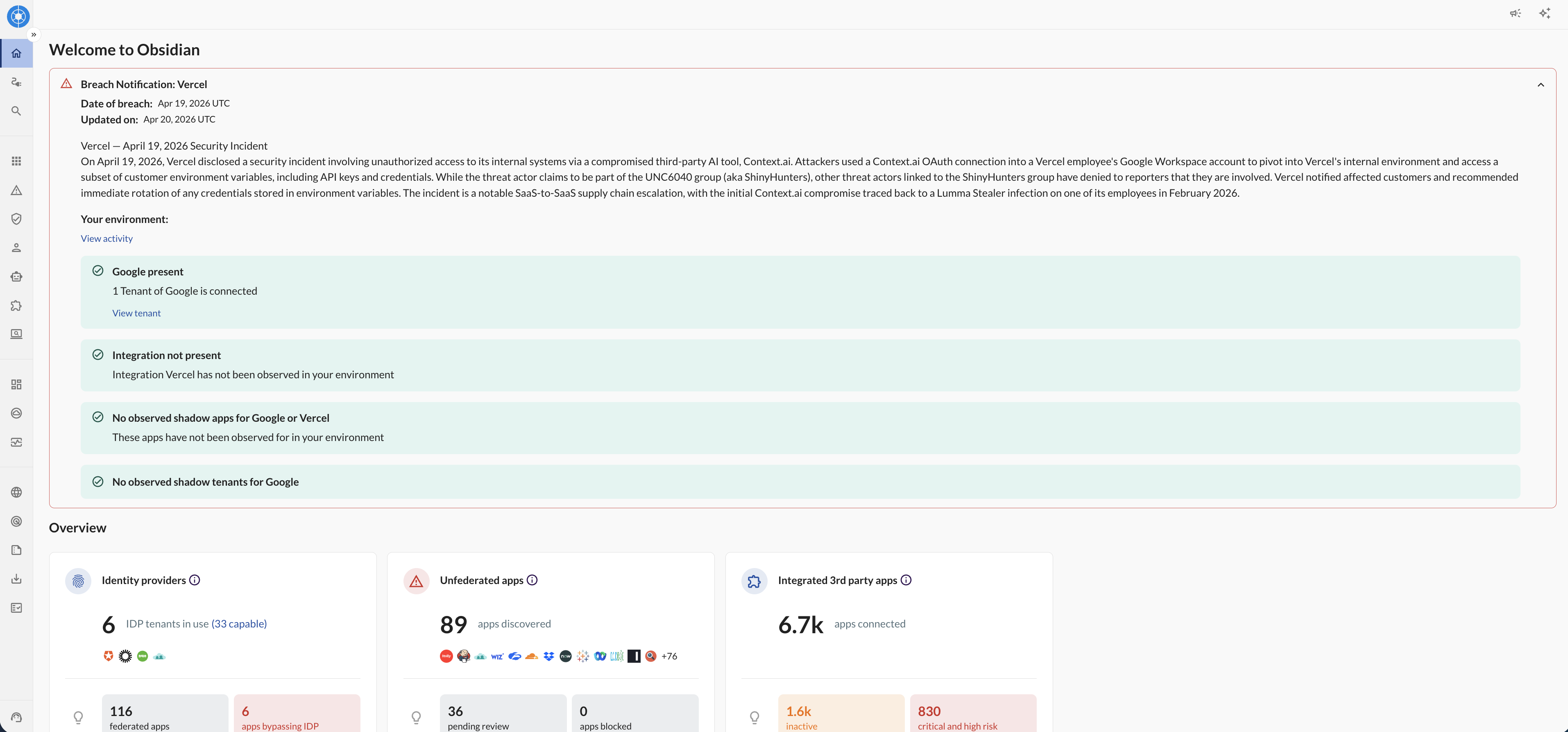
Obsidian customers woke up this morning with answers already in their console, and were able to fast track their incident response.
- Context AI flagged across your environment. Obsidian continuously inventories every OAuth application connected to your enterprise, including shadow integrations that employees connect without IT involvement. Context AI's client ID was already tracked, and affected integrations surfaced immediately when the breach became public.
- Blast radius, not just exposure. Knowing which accounts had Context AI connected is only half the picture. Obsidian maps what those accounts can reach – GitHub repos, Google Drive, internal docs, downstream SaaS tools – so your team knows the real scope of potential access, not just the entry point.
- Behavioral baseline for every integration. Obsidian builds a normal activity model for each connected app, where it connects from, what it accesses and how often. When a token is hijacked and used from attacker-controlled infrastructure, the deviation from baseline is detectable. This is how you catch compromised credentials before the exfiltration, not after.
- No manual hunting required. For most teams, an incident like this means hours of log pulling and manual cross-referencing. Obsidian customers get a prioritized list of affected identities, their permissions, and suspicious activity, to accelerate response.
The Longer-Term Problem to Solve
The Vercel breach isn’t a one-off. It’s a pattern. In the last two years, high-profile SaaS supply chain attacks have hit Okta, Twilio, Cloudflare, Snowflake and now Vercel – all stemming from third-party integrations with standing access to core systems. The attack surface grows every time an employee connects a new tool.
The response most organizations reach for – better employee training, stricter OAuth approval process – helps at the margins. But it doesn't address the core problem: you can't manually track hundreds of OAuth connections, understand what each one can access, and monitor how each one behaves over time. This problem only further exacerbates with the adoption of AI agents.
Traditional solutions don't discover these integrations, can't evaluate their permissions, and have no visibility into the cross-app activity that happens between connected systems. But that’s increasingly how attackers are escalating access and moving laterally.
What defense actually looks like is knowing, at any moment, which third-party apps are connected to your environment, what those connections can reach, and whether they're behaving normally. Not after an incident. All the time.
The question worth asking your security team this week
If one of your connected SaaS vendors or AI agent integrations was compromised tonight, how long would it take you to know which accounts were affected, what those accounts could reach, and whether the token had already been used? If the honest answer is "hours" or "we'd have to check manually", that's the gap Obsidian is built to close.
At Obsidian, we’ve been focused on providing security teams a unified view of every OAuth application, token, and permission across their enterprise app environment (including shadow integrations like Context AI that may be connected without IT awareness). For every integration, you get a living model that tracks how access and behavior change over time.
When a third-party integration is implicated in an incident, Obsidian delivers immediate blast radius clarity: which accounts are connected to the compromised tool, what those accounts can reach, and where suspicious activity is occurring. Instead of starting an investigation from scratch, your team starts with full context.
See how Obsidian secures your SaaS supply chain.
Watch NowRelated: the anatomy of a SaaS supply-chain attack and TPRM in the AI era.