HEAD-TO-HEAD
Harmonic vs. Obsidian
Harmonic watches what employees put into AI. The breach plays out in Salesforce, Workday, and your third-party apps.
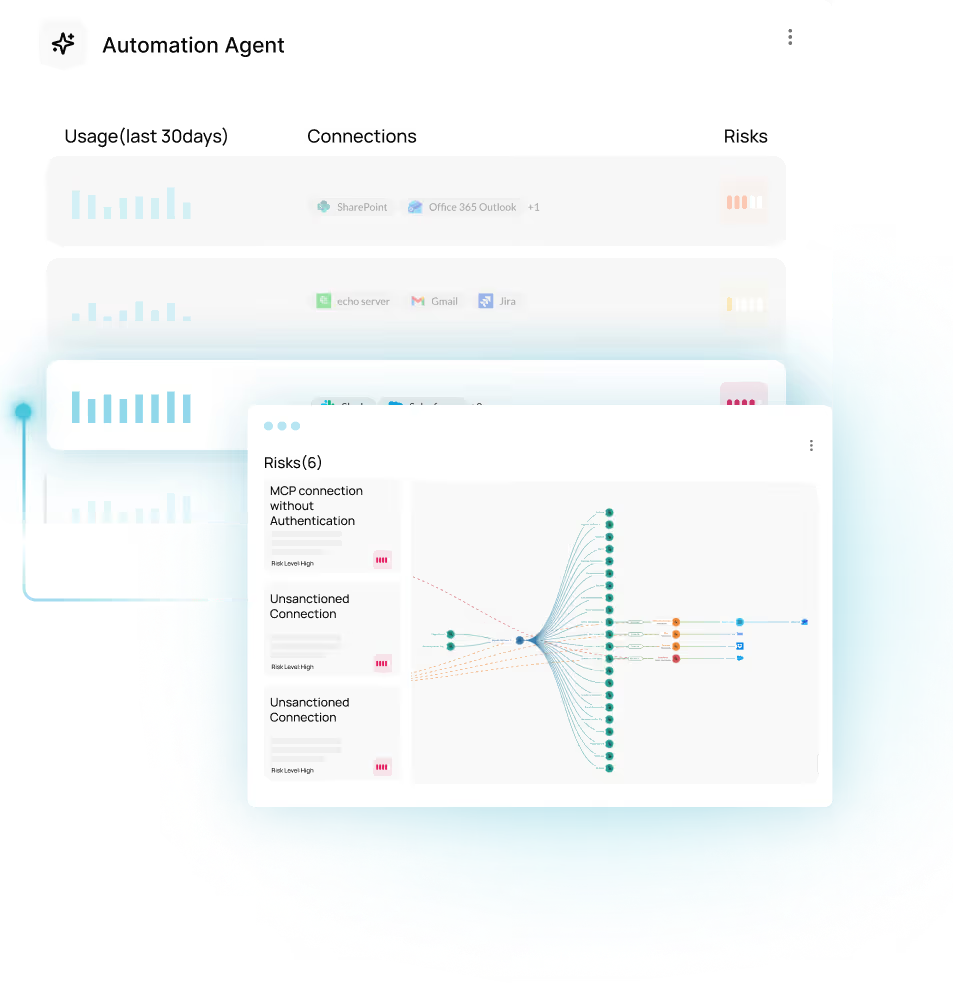
Harmonic watches what employees put into AI. The breach plays out in Salesforce, Workday, and your third-party apps.
Both platforms reduce AI risk. They work on opposite sides of it: the data your people send to AI tools, and the access your agents already hold.


.svg)




.avif)

.avif)




Harmonic Security is an AI data protection platform. Its center of gravity is the person in front of the AI tool: discovering which AI applications employees use, classifying what they are about to share, and coaching or blocking in the moment.
Obsidian secures the agents operating inside your third-party applications. It discovers every agent across Bedrock, Azure, Copilot, ChatGPT, Claude, Vertex, Agentforce, and n8n, resolves what each one can actually reach after entitlements and service-account permissions resolve, scores the combinations that create real exposure, and enforces at runtime inside the app. Controlling what people type is a starting point. Obsidian governs the access agents already hold.
It covers one direction of it. Harmonic addresses data moving from your people into AI tools. That leaves the other direction: agents your teams have already deployed inside sanctioned SaaS platforms, holding service-account credentials and acting on enterprise data without a person in the loop. Those agents never pass through a browser or a managed endpoint. Obsidian connects to the applications they act on and shows what each agent can reach, what it did, and which identity it used.
This is the one place the two genuinely overlap, and both use browser telemetry. The difference is what happens after discovery. Harmonic's catalog is oriented around AI tools employees are using so you can coach or block that usage. Obsidian's discovery extends into agents deployed inside your sanctioned SaaS platforms, then attaches each one to an owner, a service account, a set of resolved permissions, and an activity record. Discovery is the starting point. The question that follows is what the agent can reach.
No. Obsidian is a control plane and identity graph, not an inline proxy. We do not sit between the user and the model. We observe and enforce using the state of the applications agents act on: permissions, configuration, verified identity, and activity. If your requirement is inline interception of MCP traffic, that is a different control, and Harmonic offers it.
Yes, and this is the pairing that makes the most sense of the three comparisons on this site. There is minimal product overlap outside shadow AI discovery. Harmonic protects the input path from your employees into AI tools at the endpoint. Obsidian governs the agents already operating inside your SaaS applications with delegated access. Different risks, different layers.
Not in the core platform, and we don't claim it. Obsidian does not redact content in flight or filter prompt-level manipulation. Obsidian's layer is the agent's effective authority and its runtime behavior: what it is permissioned to reach after all entitlements resolve, what it actually touched inside the connected app, and whether that action should have been allowed.
Discovery tells you an agent exists. It does not tell you the agent holds a service account with organization-wide read access to a system of record. By the time a posture or inventory finding lands, the agent has often already executed. Runtime enforcement fires at the tool call, before the action completes, using the SaaS state and identity context that decide whether the action is actually risky.
99.99% uptime over the last 12 months. Regional hosting across the US, Europe, Saudi Arabia, and Australia. Granular RBAC scoped per app. Production-safe connectors with bulk-API support. Obsidian connects to your most critical SaaS apps and collects activity data without disrupting them. Learn more about our certifications and attestations.
These come from real customer environments, including customers who have evaluated Harmonic and Obsidian.
Yes, directly. Obsidian applies guardrails to Claude Code and Cowork permissions and actions: inventory of models, skills, hooks, plugins, and MCP servers, blocking unsanctioned MCP servers and apps, detecting agents reading sensitive local files such as cloud credentials and private keys, detecting secrets embedded in skills, right-sizing over-privilege, and runtime block, warn, or require-approval with an exception and policy audit trail. See Claude Code coverage. The difference stays the same as everywhere else on this page: Harmonic inspects what passes through the endpoint and the MCP gateway, Obsidian reads the permissions and activity on the other side of the call.
Most teams evaluating this category run three or four vendors side by side. We publish the same head-to-head breakdown for Zenity, Noma, Onyx, Geordie, and the SaaS security platforms agents run on top of. The through-line is the same in every one: agent-layer tools read the agent, and Obsidian reads the application the agent acts on. Which matters more depends on where your risk actually lands.
See what gives Obsidian the edge over others


.svg%201.svg)


