HEAD-TO-HEAD
Geordie vs. Obsidian
Geordie observes the agent. The breach plays out in Salesforce, Workday, and your third-party apps.
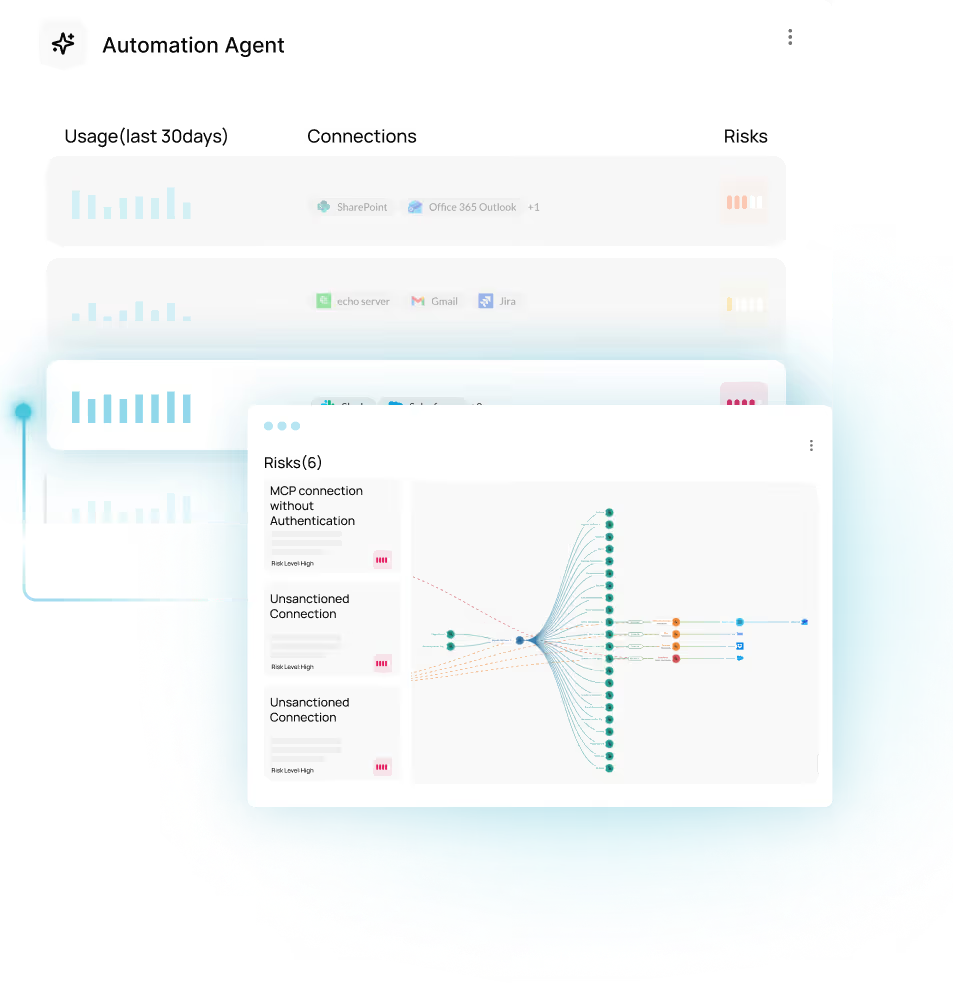
Geordie observes the agent. The breach plays out in Salesforce, Workday, and your third-party apps.
Both platforms secure AI agents. The difference is the layer each platform prioritizes and the data each one reads.


.svg)




.avif)

.avif)




It is half of it. A tool invocation tells you what the agent asked for. It does not tell you what the application gave back. When an auditor or an incident responder asks which customer records were exposed, the answer lives in the SaaS application's own activity log, tied to the service account that made the call and the entitlements that resolved behind it. Obsidian reads that side natively, so the agent-side record and the application-side record line up into one account of what actually happened.
Both enforce at runtime, and neither of us is a gateway. The difference is what each policy reads when it fires. Agent-side runtime can control what an agent does at the tool-call level. Obsidian extends runtime decisioning with SaaS state, identity, and permissions, so policies can be more specific over time: for example, don't touch a file in OneDrive labeled sensitive, when the agent was built by a specific user, calling on behalf of a specific identity. That granularity comes from reading the receiving app's state and identity context, not just the agent's tool calls.
Discovery is table stakes now, and Geordie does it well. Inventory is the starting point, not the finish. Obsidian shows who built the agent, who ran it, and what the service account inside the SaaS app is permissioned to do once every entitlement resolves. That gives defenders the context to understand which agents create real business risk and align configuration to that risk.
Geordie ships strong framework mappings across OWASP, NIST, ISO 42001, and the EU AI Act. The harder question is whether a checklist-passing agent inventory catches the breach. An agent can clear every governance control on paper and still hold a toxic combination of entitlements that is only visible from inside the connected SaaS apps. Obsidian builds the evidence layer that governance reporting depends on: agent ownership, resolved effective authority, and the activity record showing what the agent actually did.
You can, and some teams will. There is overlap at the discovery and agent-configuration layer, where both products read similar agent-platform telemetry. There is no overlap on the SaaS side, where Obsidian reads the receiving application's activity, entitlements, and identity context. If you are consolidating, pick the platform that also reads the layer the other cannot.
Posture detection tells you an agent looks risky. By the time a posture finding lands, the agent has often already executed. Runtime enforcement fires at the tool call, before the action completes. Both platforms have moved to runtime for this reason. The remaining question is what each runtime can read: agent inputs and outputs alone, or also the SaaS state and identity context that decide whether the action is actually risky.
99.99% uptime over the last 12 months. Regional hosting across the US, Europe, Saudi Arabia, and Australia. Granular RBAC scoped per app. Production-safe connectors with bulk-API support. Obsidian connects to your most critical SaaS apps and collects activity data without disrupting them. Learn more about our certifications and attestations.
These come from real customer environments, including customers who have evaluated Geordie and Obsidian.
Most teams evaluating this category run three or four vendors side by side. We publish the same head-to-head breakdown for Zenity, Noma, Onyx, Harmonic, and the SaaS security platforms agents run on top of. The through-line is the same in every one: agent-layer tools read the agent, and Obsidian reads the application the agent acts on. Which matters more depends on where your risk actually lands.
See what gives Obsidian the edge over others


.svg%201.svg)


