What Are Machine Identities? Security Risks & Management Guide
Learn what machine identities are, the security risks they create, and how to manage API keys, certificates, and cloud identities at scale before a breach.

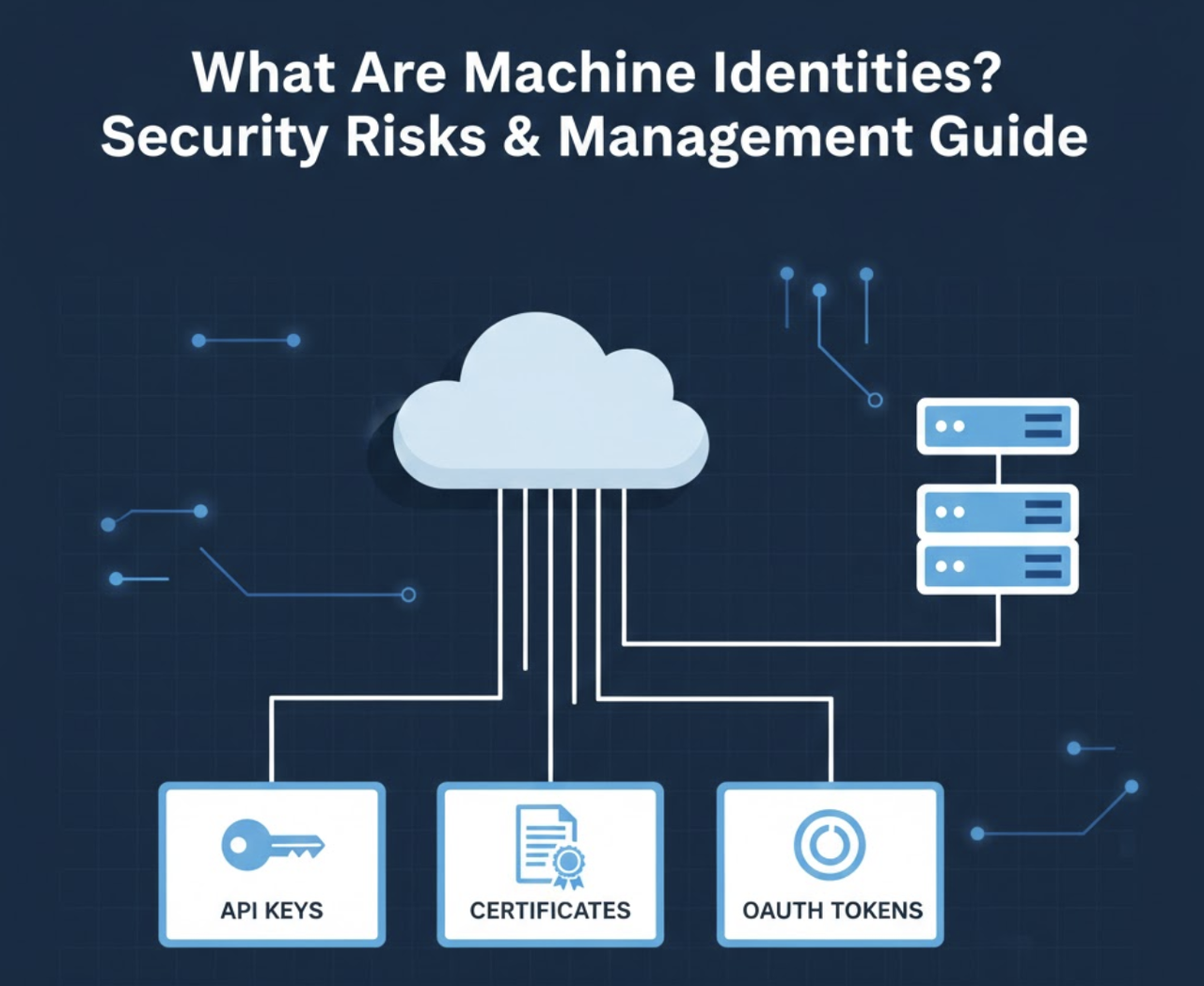
The call comes at 2 AM: payment processing is down. After hours of troubleshooting, your team discovers an expired certificate. Now you are racing to identify every system that depended on it, every application that is failing silently, every customer transaction that is stuck in limbo. This is how most organizations discover their machine identities exist: something breaks.
While your IAM strategy meticulously tracks every human user, machines are authenticating to each other millions of times per day using credentials that nobody owns, nobody rotates, and nobody monitors until an outage forces the issue.
Unlike human identities, machine identities do not complain when access is revoked. They just stop working.
Key Takeaways
- Machine identities now outnumber human identities by ratios exceeding 100:1 in enterprise environments, with some sectors approaching 500:1 as cloud-native architectures and AI adoption accelerate
- A majority of organizations have experienced security breaches tied to compromised machine identities within the past year, with API keys and TLS certificates serving as the leading attack vectors
- Most organizations have suffered at least one certificate-related outage in the past year, demonstrating that availability and security are the same problem for machine credentials
- Only a small fraction of organizations have achieved comprehensive automated lifecycle management for machine identities, leaving most dependent on manual tracking and ad-hoc processes
- Behavioral detection is essential because point-in-time inventories cannot identify when credentials are used from unexpected infrastructure, access data outside normal patterns, or operate during anomalous timeframes
What Are Machine Identities?
Machine identities are the credentials that authenticate software, services, devices, and automated systems to each other without human intervention. They represent the invisible handshakes happening millions of times per day across your infrastructure: API calls between microservices, certificate validations during TLS connections, service accounts executing scheduled jobs, and OAuth tokens enabling SaaS integrations.
These credentials function as digital proof of identity, allowing one machine to verify that another machine is authorized to perform specific actions. Most SaaS apps implement OAuth tokens as bearer tokens, something like a key. Whoever has this key can use it.
Machine identities are a core subset of non-human identities (NHIs), which encompass all digital entities that interact with systems without direct human control. While all machine identities are NHIs, the broader category also includes legal entities, software bots, and robotic process automation (RPA) accounts.
The distinction matters because organizations across sectors predict continued growth in machine identity volume, with a meaningful share expecting radical increases of 50 percent or more. This exponential expansion is driven by:
- Cloud-native architectures where containerized workloads spawn temporary identities for each deployment
- Microservices patterns requiring service-to-service authentication across distributed systems
- DevOps automation creating credentials for CI/CD pipelines, infrastructure-as-code tools, and deployment scripts
- AI and ML workloads generating service accounts for model training, inference endpoints, and data pipeline orchestration. Research shows agents can hold 10x more access than their workflows actually need, compounding the machine insider risk at scale
- SaaS integration sprawl where each third-party connection introduces OAuth tokens with inherited permissions
The operational reality is stark: enterprises now manage machine identities at ratios exceeding 100:1 compared to human users. Yet most organizations admit they do not prioritize securing machine identities as a distinct discipline, leaving critical gaps for attackers to exploit.
The Four Categories of Machine Identities
Understanding What Are Machine Identities? Security Risks & Management Guide requires recognizing that not all machine credentials function the same way. Each category introduces distinct attack vectors and operational challenges.
Certificates: The Ticking Clock Problem
SSL/TLS certificates authenticate servers and encrypt communications between systems. Code signing certificates validate software integrity during deployment. SSH certificates enable server-to-server access for administrative tasks.
The problem is not complexity: it is scale and tracking. A single expired certificate can cascade into widespread outages. The Equifax breach exploited an expired certificate that disabled security monitoring, allowing attackers to move freely during the blind spot.
Most organizations have suffered at least one certificate-related outage in the past year. Expiration is predictable, but tracking thousands of certificates distributed across cloud providers, on-premises infrastructure, and SaaS platforms is not. When certificates expire, applications fail silently. Payment processing stops. API integrations break. Customer-facing services go dark.
Certificate outages become security incidents when monitoring tools lose visibility, backup systems fail to authenticate, or incident response teams cannot access compromised systems.
API Keys and Tokens: The Bearer Credential Risk
OAuth tokens enable SaaS integrations between platforms like Salesforce and marketing automation tools. API keys authenticate service-to-service communication in cloud environments. JWTs (JSON Web Tokens) carry identity claims between microservices.
These are bearer credentials. Whoever holds them gets access. There is no secondary verification, no MFA challenge, no behavioral analysis. The token itself is proof of authorization.
Refresh tokens are especially risky because, like service accounts, they operate outside traditional login flows. They persist for months or years, granting continuous access without re-authentication. Most organizations believe SSO and MFA protect them. In reality, OAuth tokens function independently of your SSO/MFA infrastructure.
API keys and TLS certificates are consistently among the leading attack vectors in machine identity-related incidents. When attackers steal an API key from a GitHub repository (even private repos get breached), they inherit every permission that credential carries. The Snowflake breach demonstrated how stolen credentials enabled access across 165-plus customer environments, riding those trusted connections straight into production data.
For organizations managing Salesforce integration risk, the challenge is acute: third-party OAuth apps can access CRM data, customer records, and financial information through tokens that never expire and are rarely audited. Each of these OAuth grants represents a machine insider risk that operates outside the visibility of traditional IAM.
Secrets: The Sprawl Nobody Owns
Database connection strings contain credentials for accessing production databases. Encryption keys protect data at rest. Service passwords authenticate background processes and scheduled jobs.
The problem is secrets sprawl across repositories, configuration files, CI/CD pipelines, container images, and developer laptops. Nobody owns them. Nobody rotates them. Nobody knows where all the copies exist.
The Uber breach (2022) traced back to hard-coded credentials in a PowerShell script. Attackers who compromise developer workstations scan for secrets in code repositories, environment variables, and configuration management systems. Once discovered, those secrets provide persistent access that survives password resets and MFA enforcement.
Security teams discover secrets during incident response, not during proactive audits. By then, attackers have already used them to escalate privileges, access sensitive data, or establish persistence mechanisms.
Cloud Workload Identities: The Temporary That Became Permanent
AWS IAM roles, Azure managed identities, and GCP service accounts enable cloud workloads to access resources without embedding long-term credentials in code.
This is the right architectural pattern. The problem is how developers use it.
Developers create cloud identities for convenience, not security. They grant admin-level permissions to get it working, intending to reduce scope later. Temporary becomes permanent. Excessive permissions accumulate over time. Nobody remembers which workload actually needs which access.
Attackers who compromise one workload inherit all permissions attached to its identity. If that identity has admin access to S3 buckets, RDS databases, or Lambda functions, the blast radius multiplies instantly. This is lateral movement through inherited permissions: attackers do not need to steal additional credentials when the compromised identity already has overprivileged access.
Research across enterprise environments shows a significant gap between leadership perception and practitioner reality when it comes to tracking dormant or orphaned machine accounts. Those orphaned identities represent attack surface that leadership does not know exists and security teams cannot defend.
Machine Identity vs. Human Identity: Why Your IAM Strategy Falls Short
Your IAM strategy was designed for humans. It assumes identities are tied to employees, managed through HR systems, and governed by predictable lifecycle events (onboarding, role changes, termination). What Are Machine Identities? Security Risks & Management Guide exposes why those assumptions break down for machines.
Dimension Human Identities Machine Identities Volume Hundreds to thousands Tens of thousands to millions Lifecycle HR-driven (hire to termination) Project-driven (often forgotten) Authentication Password + MFA Keys, tokens, certificates Behavior Pattern Working hours, typical locations 24/7, any location, any volume Credential Rotation Quarterly password changes Often never Ownership Manager-assigned Unclear (platform team? developer? nobody?) Audit Trail Login events, access reviews Scattered across logs, if captured at all Decommissioning Automated via HR offboarding Manual, if remembered
The fundamental difference is accountability. Human identities have managers who certify access during quarterly reviews. Machine identities have no manager. Nobody receives a notification when a service account is created. Nobody certifies that an API key still needs admin permissions. Nobody decommissions the OAuth token when the integration is no longer used.
This is why a large share of organizations lack a unified approach to securing machine identities. The tools designed for human IAM cannot handle the scale, lifecycle, or behavioral patterns of machines. Point-in-time access reviews cannot capture the daily churn of machine identity creation. Static inventories cannot detect when credentials are used from unexpected infrastructure or access data outside normal patterns.
For security teams managing SaaS security posture, the challenge is compounded by integration sprawl. Each OAuth connection introduces machine identities that bypass traditional IAM controls, operating in the visibility gap between SaaS applications where traditional security tools have limited reach.
The Security Risks Hiding in Plain Sight
What Are Machine Identities? Security Risks & Management Guide reveals how machine credentials create attack paths that traditional security controls miss entirely.
Certificate Outages Become Security Incidents
An expired certificate disables a monitoring tool. Attackers move freely during the blind spot. What started as an availability problem becomes a security incident.
This is not theoretical. Certificate-related outages affect most organizations every year. When certificates expire:
- Security monitoring tools lose visibility into network traffic, application behavior, or user activity
- Backup systems fail to authenticate, preventing disaster recovery during incidents
- Incident response teams cannot access compromised systems because SSH certificates or VPN credentials no longer validate
- Compliance controls fail, triggering audit findings and regulatory notifications
The impact extends beyond immediate outages. Organizations that have experienced certificate-related incidents report delays in application launches, service outages, and unauthorized access to sensitive systems. Certificate expiration is predictable. The cascading security consequences are not.
API Key Sprawl Creates Lateral Movement Paths
A developer commits an API key to GitHub. Even private repositories get breached. That key is used in multiple environments: development, staging, production. The blast radius multiplies instantly.
This is exactly how the Snowflake breach unfolded: stolen credentials enabled access across 165-plus customer environments. Attackers did not need to compromise each customer individually. They rode trusted connections from one environment to another, using machine credentials that operated outside SSO/MFA controls.
API key sprawl creates lateral movement paths because:
- Keys are copied across environments during development and deployment
- Keys persist in code repositories long after the original use case is retired
- Keys grant broad permissions because developers prioritize functionality over least privilege
- Keys operate 24/7 from any location, making behavioral anomalies difficult to detect
For organizations managing third-party SaaS integration risk, the challenge is acute. OAuth tokens enable third-party applications to access internal data through inherited permissions. When that third party is breached, attackers inherit the same access: reading customer records, modifying configurations, or exfiltrating sensitive data. The toxic combinations of over-scoped tokens, orphaned integrations, and absent ownership make each OAuth grant a potential pivot point.
Cloud Identities Accumulate Toxic Permissions
A cloud role is created with admin access temporarily to troubleshoot a production issue. Temporary becomes permanent. Nobody reduces the permissions. Nobody tracks which workloads actually use that identity.
Attackers who compromise one workload inherit all permissions attached to its cloud identity. If that identity has admin access to S3 buckets, RDS databases, or Lambda functions, the attacker gains immediate access to sensitive data without additional credential theft.
This is the toxic combination of overprivileged permissions and unclear ownership. Most security leaders acknowledge that every undiscovered machine identity is a potential point of compromise. Yet most organizations cannot answer basic questions:
- Which workloads are using this cloud identity right now?
- What data does this identity actually access?
- Why does this service account have admin-level permissions?
- Can we rotate this credential safely without breaking production?
The operational burden is significant. Security teams discover machine identities during incident response, not during proactive governance. By then, attackers have already exploited the overprivileged access to establish persistence, escalate privileges, or move laterally across cloud environments.
From Inventory to Continuous Monitoring
Point-in-time audits miss the daily churn of machine identity creation. A security team exports a list of service accounts on Monday. By Friday, developers have created dozens more through infrastructure-as-code deployments, CI/CD pipeline automation, and SaaS integration workflows.
Static inventories cannot detect behavioral anomalies. Knowing that an API key exists does not tell you:
- Whether it is being used from unexpected infrastructure
- Whether it is accessing data outside normal patterns
- Whether it is active during anomalous timeframes
- Whether the permissions it carries are still necessary
You need to know not just what identities exist, but how they are being used. This is the difference between inventory and runtime truth.
This is where point-in-time configuration scanning falls short. Snapshot-based tools identify misconfigurations and compliance gaps in SaaS application settings. But they cannot detect when a legitimate OAuth token is used by an attacker who stole it from a developer's laptop. That gap between a theoretical configuration and actual runtime behavior is where machine identity attacks live.
Behavior versus inventory is the fundamental distinction. Inventory tells you what exists. Behavioral detection tells you what is happening.
Behavioral Signals That Indicate Compromise
Continuous monitoring for machine identities focuses on deviations from established baselines:
- Certificate used from unexpected infrastructure: A certificate issued for us-east-1 suddenly authenticates connections from an unfamiliar AWS region or IP address range
- API key accessing data outside normal patterns: A marketing automation token that typically reads contact records suddenly attempts to export entire customer databases
- Cloud identity assuming roles it has never assumed before: A Lambda execution role that historically accessed only DynamoDB suddenly attempts to assume an IAM role with S3 admin permissions
- Service account active outside maintenance windows: A backup service account that operates daily at 2 AM suddenly authenticates at 3 PM on a Tuesday
These behavioral signals indicate compromise because attackers use stolen credentials differently than legitimate workloads. They explore the environment, test permissions, and exfiltrate data in patterns that deviate from the baseline. This is ghost chasing in practice: the credential appears legitimate, but the behavior reveals the threat.
The challenge is establishing those baselines across thousands or millions of machine identities. This requires continuous discovery, relationship mapping, and anomaly detection: capabilities that traditional IAM tools were not designed to provide.
The Operational Burden (And How to Reduce It)
Security teams discover machine identities during incident response. A certificate expires and breaks production. An API key appears in a breach notification. A cloud identity shows up in audit logs performing suspicious actions.
Manual tracking in spreadsheets guarantees gaps. By the time the spreadsheet is updated, the infrastructure has changed. New identities have been created. Old identities persist because nobody is confident enough to remove them.
Platform teams create identities to enable functionality. Security teams inherit the risk. This organizational disconnect is why only a small fraction of organizations have achieved comprehensive automated lifecycle management for machine identities.
The operational burden includes:
- Discovery: Finding all machine identities across SaaS, cloud, and on-premises environments
- Classification: Determining which identities are critical, which are dormant, which are overprivileged
- Ownership assignment: Identifying who is responsible for each identity's lifecycle
- Risk assessment: Evaluating what data each identity can access and what damage it could cause if compromised
- Rotation planning: Determining which credentials can be rotated safely without breaking production
- Decommissioning: Removing identities that are no longer needed without triggering outages
Each step requires coordination across security, platform, and development teams. Each step introduces friction that delays remediation.
What Visibility Actually Requires
Reducing the operational burden requires automating the foundational work that currently consumes security team capacity:
Continuous discovery across SaaS, cloud, and on-premises environments ensures that new machine identities are identified as they are created, not weeks later during a manual audit. This includes:
- OAuth tokens enabling SaaS integrations
- Cloud workload identities (IAM roles, managed identities, service accounts)
- API keys embedded in applications and scripts
- Certificates distributed across infrastructure
- Service accounts in Active Directory and cloud directories
Relationship mapping connects machine identities to the resources they access. This answers critical questions about effective authority: which identity accesses which data, what is the blast radius if this identity is compromised, which identities have inherited permissions through integration chains, and what toxic combinations exist (overprivileged access to sensitive data)?
Behavioral baseline establishes what normal looks like for each identity:
- Typical access patterns (which APIs, which data, which timeframes)
- Expected infrastructure (IP ranges, cloud regions, network segments)
- Historical permission usage (which scopes are actually exercised)
- Lifecycle patterns (creation, modification, last use)
Anomaly detection alerts when patterns change:
- Identity used from unexpected infrastructure
- Access to data outside normal scope
- Permission escalation attempts
- Activity during anomalous timeframes
- Credential sharing across multiple workloads
This is the operational model that makes machine identity security sustainable. Instead of discovering identities during incident response, security teams gain continuous visibility into what is operating in their environment before the next certificate expiration becomes a security incident.
For organizations managing AI agent security risks or GenAI security, the challenge is even more acute. AI workloads generate machine identities at unprecedented scale: service accounts for model training, API keys for inference endpoints, OAuth tokens for data pipeline integrations. Research shows that agents can hold 10x more access than their workflows actually need, which means AI adoption creates machine insider risk at a scale that manual tracking cannot address. Without automated discovery and behavioral monitoring, those visibility gaps become the attack surface.
Conclusion
What Are Machine Identities? Security Risks & Management Guide exposes the infrastructure problem that most security teams discover too late: machine credentials are multiplying faster than your team can track them, operating outside traditional IAM controls, and creating attack paths that bypass SSO and MFA.
The pattern is consistent across organizations. A majority have experienced security breaches tied to compromised machine identities. Most have suffered certificate-related outages. Only a small fraction have achieved automated lifecycle management. The gap between the scale of the problem and the maturity of security controls is widening.
Traditional approaches fail because they assume machine identities behave like human identities. They do not. Point-in-time audits miss the daily churn of credential creation. Static inventories cannot detect behavioral anomalies. Manual tracking in spreadsheets guarantees gaps that attackers exploit.
The solution requires shifting from inventory to continuous monitoring. Security teams need to know not just what machine identities exist, but how they are being used: which infrastructure they authenticate from, which data they access, which permissions they exercise, and when their behavior deviates from baseline. That runtime truth is what separates reactive incident response from proactive machine identity security.
Next Steps
Map your machine identity risk before the next certificate expiration becomes a security incident:
- Conduct continuous discovery across SaaS, cloud, and on-premises environments to identify all machine credentials operating in your infrastructure
- Establish relationship mapping to understand which identities access which data and what the blast radius would be if compromised
- Implement behavioral monitoring to detect when credentials are used from unexpected infrastructure, access data outside normal patterns, or operate during anomalous timeframes
- Automate lifecycle management for certificate rotation, API key expiration, and cloud identity decommissioning
- Assign clear ownership for every machine identity with escalation paths when anomalies are detected
Machine identities are multiplying faster than your team can track them. Obsidian discovers machine identities across your SaaS environment, maps their relationships to sensitive data, and alerts when behavior deviates from baseline. See what is operating in your environment with continuous SaaS security monitoring that extends beyond static posture management.
Do not wait for the 2 AM call about payment processing being down. Gain visibility into the hidden layer of machine credentials before attackers exploit them.
The AI-agent-specific version of this problem is covered in what machine identity means for AI agents.