Credential Theft vs Token Theft: Understanding the Difference
Learn how credential theft and token theft differ, why tokens bypass MFA, and detection strategies for both attack vectors in SaaS environments.

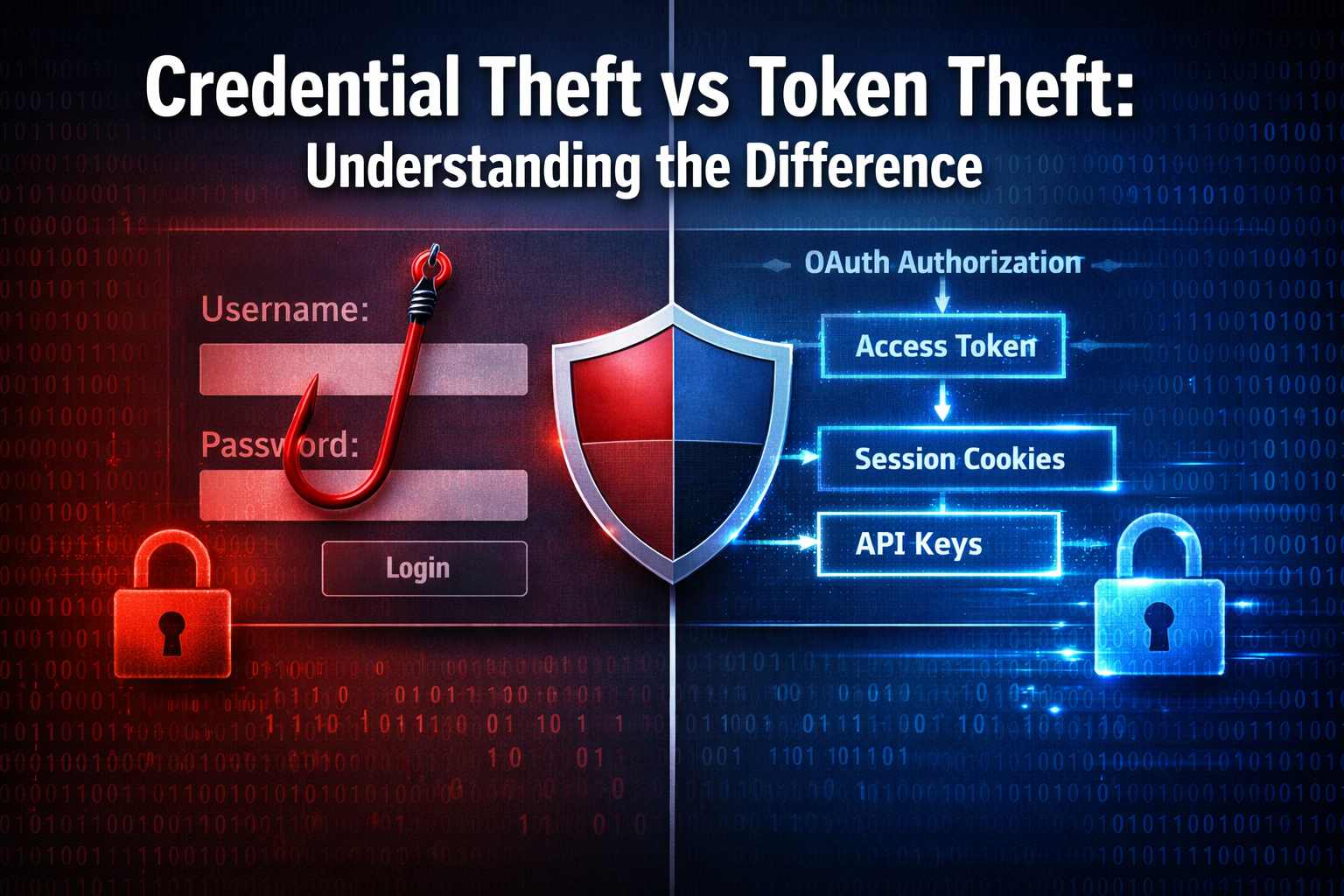
Credential theft involves stealing usernames and passwords through phishing, keyloggers, or breach databases. Attackers must then authenticate using those credentials, triggering login events and potentially MFA challenges. Token theft steals active session tokens or OAuth refresh tokens that function like keys; whoever holds the token gains immediate access without authentication. Most critically, stolen tokens bypass MFA entirely because they represent already-authenticated sessions. While credential theft remains the dominant attack vector at 88% of breaches, token theft is rapidly emerging as the preferred technique for sophisticated attackers targeting SaaS environments, with PhaaS platforms now capturing both simultaneously in 63% of incidents.
Key Takeaways
• Credential theft targets usernames and passwords through phishing, malware, and social engineering, while token theft steals session tokens and OAuth refresh tokens that bypass login requirements entirely
• Token theft bypasses MFA completely; attackers use stolen bearer tokens to impersonate legitimate users without ever needing passwords or authentication codes
• 88% of data breaches involve stolen or weak credentials, but PhaaS platforms now steal both credentials and tokens simultaneously in 63% of account compromise incidents
• Threat actors exploit stolen credentials within an average of 14 minutes, leaving minimal detection windows for security teams
• Traditional credential-focused defenses miss token-based attacks because OAuth tokens operate independently of SSO and MFA controls
• Behavioral detection that monitors token usage patterns, ASN deviation, and User-Agent attribution catches attacks that credential monitoring alone cannot detect
• Organizations need unified visibility across both credential and token abuse to prevent SaaS-to-SaaS lateral movement and account takeover
What Is Credential Theft and How Does It Work?
Credential theft is the unauthorized acquisition of authentication data: usernames, passwords, MFA codes, or security questions, through technical compromise, social engineering, or insider actions.
Attackers steal credentials through multiple proven methods. Phishing campaigns trick users into entering credentials on fake login pages that mimic legitimate services. These attacks accounted for 22% of initial access vectors in 2025, tied with vulnerability exploitation. Keylogging malware records every keystroke, capturing passwords as users type them. Credential stuffing leverages the 312 million compromised credentials circulating in dark web marketplaces; attackers test these stolen username/password pairs across multiple platforms, exploiting password reuse.
The scale is staggering. Security teams blocked 4.2 billion credential stuffing attempts in 2025, representing 47% year-over-year growth. Organized crime groups now operate credential stuffing as a service, testing 26 billion attacks per month globally.
Infostealer malware represents the fastest-growing credential theft method. These tools exfiltrate passwords directly from browser memory before hashing occurs. The result: 68.89% of breached credentials now exist in plaintext, a 261% year-over-year increase[Personal information]. Freshness matters critically; credentials less than 30 days old have 10x higher success rates than older leaks.
Once attackers obtain credentials, they must authenticate. This triggers login events, generates authentication logs, and may prompt MFA challenges. Organizations with robust identity threat detection can spot anomalous login patterns, impossible travel scenarios, or suspicious device fingerprints during this authentication phase.
Common credential theft mistake: Assuming MFA completely prevents credential-based attacks. While MFA significantly raises the bar, PhaaS platforms now use Adversary-in-the-Middle techniques to capture both credentials and session tokens simultaneously, bypassing MFA entirely.
What Is Token Theft and Why It Bypasses Traditional Defenses?
Token theft targets active session tokens, OAuth refresh tokens, and API keys that grant access without requiring authentication.
Unlike credentials that require login, tokens function as bearer tokens, digital keys that grant access to whoever possesses them. Most SaaS applications implement OAuth tokens this way. An attacker who steals a valid refresh token can generate new access tokens indefinitely, maintaining persistent access without ever triggering a login event.
OAuth token theft emerged as a dominant technique in December 2025 when attackers began registering malicious OAuth apps to hijack legitimate tokens in real-time[Personal information]. These attacks grant full read/write/send access to email, calendars, files, and administrative functions. The technique primarily targets Microsoft 365 environments and has compromised over 44% of North American victims in technology, manufacturing, and financial sectors[Personal information].
Session hijacking differs from credential theft in a critical way: it leaves no authentication footprint. Traditional security controls monitor login events, failed authentication attempts, and MFA challenges. Token theft bypasses all of these. The attacker uses an already-authenticated session, appearing identical to legitimate user activity.
Refresh tokens pose especially high risk because they operate outside traditional login flows. They persist for extended periods, sometimes months or years, granting continuous access without re-authentication. When an attacker steals a refresh token, they inherit all the permissions of the compromised account, including any integrations and third-party app connections.
The attack timeline compresses dangerously. Most fraud occurs within the first 24 hours after account takeover, with median attack duration increasing to 3.2 hours in 2025. Organizations relying solely on credential-focused defenses miss these attacks entirely until data exfiltration or lateral movement triggers behavioral alerts.
Choose token-focused detection if your environment includes: SaaS applications with OAuth integrations, service accounts with API access, or third-party apps connected to core platforms like Salesforce, Microsoft 365, or Google Workspace. For comprehensive protection strategies, review our guide on how to stop token compromise.
How Attackers Combine Credential and Token Theft in Modern Campaigns
Sophisticated threat actors no longer choose between credential theft and token theft; they execute both simultaneously.
PhaaS (Phishing-as-a-Service) platforms account for 63% of all account compromise incidents by using Adversary-in-the-Middle (AitM) techniques. These platforms position themselves between the victim and the legitimate login page, capturing credentials as the user enters them while simultaneously stealing the session token generated after successful authentication.
The attack flow works like this: A victim receives a phishing email with a link to a fake login page. When they enter their credentials, the PhaaS platform forwards those credentials to the real service, completing authentication. The legitimate service generates a session token and returns it to the user. The AitM platform intercepts this token, now possessing both the plaintext credentials and an active session token that bypasses MFA.
This dual-theft approach maximizes attacker options. If the organization forces a password reset, the attacker still holds valid session tokens. If the organization revokes active sessions, the attacker can re-authenticate using the stolen credentials. The only effective mitigation requires both credential rotation and session invalidation simultaneously.
Integration chains amplify risk. When attackers compromise a token for an account with OAuth integrations, they inherit access to every connected application. A single compromised Salesforce token might grant access to marketing automation platforms, customer success tools, and analytics systems, all without triggering additional authentication. This creates SaaS-to-SaaS lateral movement opportunities that traditional perimeter defenses cannot detect.
Real-world example: The Salesloft-Drift incident demonstrated how a single OAuth integration extended compromise into tools like Gainsight and multiple Salesforce instances, multiplying the number of affected companies to more than 700 organizations. For detailed analysis of this attack pattern, see our breakdown of phishing and token compromise in SaaS environments.
Organizations need visibility into both credential exposure and token behavior. Monitoring credentials alone misses token-based persistence. Monitoring tokens alone misses the initial compromise vector. Unified detection across both attack surfaces provides the operational reality security teams need.
Detection Strategies: Credential Monitoring vs Token Behavior Analysis
Detecting credential theft and token theft requires fundamentally different approaches because the attack signatures differ.
Credential theft detection focuses on authentication events. Security teams monitor for failed login attempts, impossible travel (logins from geographically distant locations within impossible timeframes), new device registrations, and authentication from suspicious IP addresses or ASNs. Tools like SIEM platforms, identity providers, and ITDR solutions excel at spotting these patterns.
Key credential theft indicators include:
• Multiple failed authentication attempts followed by successful login (credential stuffing)
• Login from IP address with known malicious reputation
• Authentication from unfamiliar device or browser fingerprint
• Geographic anomaly (user in New York, login from Eastern Europe)
• Unusual authentication time (3 AM login for user who typically works 9-5)
• Downgrade from MFA to password-only authentication
Token theft detection requires behavioral analysis because authentication logs provide no visibility. Attackers using stolen tokens generate no login events. Instead, security teams must monitor post-authentication activity for anomalies.
Effective token theft detection examines:
• User-Agent attribution: Does the token usage match the device/browser that originally authenticated?
• ASN deviation: Is the token being used from a different network provider than the original authentication?
• API call patterns: Does the volume, timing, or type of API requests match historical user behavior?
• Data access anomalies: Is the user suddenly accessing files, folders, or records they've never touched before?
• Permission escalation: Is the token being used to modify admin settings or grant new privileges?
• Integration abuse: Is the token accessing third-party apps or OAuth connections the user doesn't typically use?
The challenge: Traditional security tools provide static visibility, specifically snapshots at certain points in time. They capture authentication events but miss the changing relationships between SaaS applications, tokens, and data movement. This is where behavioral detection using Knowledge Graph correlation becomes critical.
Knowledge Graph approaches map the relationships between users, tokens, applications, integrations, and data. When a token exhibits behavior inconsistent with its historical pattern: accessing different applications, moving data to new destinations, or using unfamiliar API endpoints; the system flags it as anomalous even without a corresponding authentication event.
Organizations should implement both credential monitoring and token behavior analysis. Credential monitoring catches the initial compromise. Token behavior analysis catches the persistent access and lateral movement that follows. For practical implementation guidance, review our analysis of fortifying Okta against session token compromise.
Prevention Best Practices: Protecting Against Both Attack Vectors
Preventing credential theft and token theft requires layered controls that address both the initial compromise and the post-authentication abuse.
For credential theft prevention:
• Enforce phishing-resistant MFA using hardware security keys (FIDO2/WebAuthn) that cannot be phished or bypassed by AitM attacks
• Deploy password managers to eliminate password reuse and generate unique, complex passwords for each service
• Implement continuous authentication that re-validates user identity throughout the session, not just at login
• Monitor dark web exposure for leaked corporate credentials and force immediate resets when exposure is detected
• Conduct security awareness training focused on recognizing phishing techniques, especially those targeting credentials
The reality: MFA alone is insufficient. While it blocks basic credential stuffing attacks, PhaaS platforms bypass MFA using AitM techniques in 63% of account compromise incidents. Organizations need phishing-resistant MFA methods that cryptographically bind authentication to the legitimate domain.
For token theft prevention:
• Implement short-lived access tokens with maximum lifetimes of 1 hour, forcing frequent token refresh
• Rotate refresh tokens after each use (refresh token rotation) to limit the window of opportunity if a token is stolen
• Bind tokens to device fingerprints so tokens cannot be used from different devices or browsers
• Enforce conditional access policies that re-evaluate token validity based on IP address, location, and device posture
• Monitor OAuth app permissions and revoke overprivileged or suspicious third-party integrations
• Implement token replay detection that identifies when the same token is used from multiple locations simultaneously
Critical consideration: Long-lived refresh tokens represent persistent risk. Many SaaS platforms issue refresh tokens valid for 90 days or longer. If an attacker steals one of these tokens, they maintain access for the entire validity period unless the organization explicitly revokes it.
Unified prevention strategy:
• Deploy behavioral detection that monitors both authentication patterns and post-authentication activity
• Implement zero trust architecture that continuously validates both user identity and device posture
• Maintain integration inventory documenting all OAuth connections, API keys, and service accounts
• Enforce least privilege for both user accounts and OAuth app permissions
• Automate incident response to revoke both credentials and active sessions when compromise is detected
Organizations should audit their OAuth integrations quarterly. Stale integrations with admin permissions create toxic combinations: overprivileged access sitting dormant until an attacker discovers it. For comprehensive integration security guidance, see our analysis of CircleCI and token threat integration risks.
Response Playbooks: What to Do When Credentials or Tokens Are Compromised
When credential theft or token theft is detected, response speed determines impact. Threat actors begin active exploitation within an average of 14 minutes of credential theft.
Credential compromise response:
- Force immediate password reset for the affected account across all systems
- Revoke all active sessions to invalidate any tokens generated using the compromised credentials
- Review authentication logs for the 72 hours preceding detection to identify initial access and scope of compromise
- Check for privilege escalation to determine if the attacker created new accounts or modified permissions
- Scan for persistence mechanisms including new OAuth apps, API keys, or service accounts created by the compromised user
- Notify affected users and require MFA re-enrollment if MFA was bypassed
- Document timeline and IOCs for threat intelligence and future detection tuning
Common mistake: Resetting the password without revoking active sessions. The attacker continues using valid session tokens even after the password changes. Both actions must occur simultaneously.
Token compromise response:
- Revoke the specific token immediately through the SaaS platform's admin console
- Revoke all tokens for the affected user account if the specific compromised token cannot be identified
- Audit OAuth app permissions and revoke any suspicious third-party integrations the token may have accessed
- Review API call logs to determine what data the attacker accessed, modified, or exfiltrated
- Check for lateral movement by examining which integrated applications the token accessed
- Rotate API keys and service account credentials if the compromised token had access to these resources
- Implement token binding to prevent future tokens from being used on unauthorized devices
- Force re-authentication for the user to generate new tokens with updated security controls
Unified response for combined attacks:
When PhaaS platforms steal both credentials and tokens simultaneously, the response must address both:
- Immediate session termination across all devices and applications
- Credential rotation with forced password reset and MFA re-enrollment
- OAuth app audit to identify and revoke any malicious integrations registered during the compromise window
- Integration chain analysis to determine blast radius across connected SaaS applications
- Data access review to identify what sensitive information the attacker viewed or exfiltrated
- Endpoint investigation if the compromise originated from malware or infostealer infection
Organizations should maintain pre-built playbooks for both scenarios. The 14-minute exploitation window means manual investigation processes are too slow. Automated detection and response workflows that trigger immediate containment actions provide the only realistic defense.
For detailed incident response procedures, review our case study on pass-the-cookie attacks which demonstrates token theft response in practice.
The Hidden Layer: Why Traditional Tools Miss Token-Based Attacks
Most organizations believe their SSO and MFA protect them from identity-based attacks. In reality, OAuth tokens function independently of your SSO and MFA controls.
Traditional security tools focus on the authentication layer: monitoring login events, failed attempts, and MFA challenges. This approach catches credential theft effectively because attackers must authenticate using stolen credentials. But token theft bypasses authentication entirely.
The visibility gap: CASB tools, SIEM platforms, and identity providers generate alerts when users log in. They do not generate alerts when an attacker uses a stolen token because no login occurs. The attacker appears as the legitimate user conducting normal business activities.
Static vs dynamic visibility: Many security tools provide static snapshots, showing who has access to what at a specific point in time. They miss the changing relationships between applications, integrations, and data movement. When an attacker uses a stolen token to access a new OAuth integration, static tools see "authorized access" rather than "anomalous behavior."
The integration blind spot: Organizations typically have deep visibility into their directly-managed SaaS applications. They have minimal visibility into the third-party apps and integrations connected to those platforms. When an attacker compromises a token with OAuth permissions, they ride those trusted connections straight into applications the security team doesn't even know exist.
This is the hidden layer where attackers operate, in the space between your SaaS applications where OAuth tokens, API keys, and service accounts create invisible attack paths.
Behavioral detection closes the gap by monitoring what tokens do rather than how they were obtained. Instead of asking "did this user authenticate successfully," behavioral systems ask:
• Is this token accessing data it's never touched before?
• Is this token being used from a different network than usual?
• Is this token making API calls at unusual times or volumes?
• Is this token accessing integrations the user doesn't typically use?
• Is this token exhibiting patterns consistent with automated exfiltration?
Organizations need visibility into both the authentication layer (catching credential theft) and the behavioral layer (catching token abuse). Traditional tools provide the first. Specialized SaaS security platforms provide the second. For comprehensive protection, review our guide to governing app-to-app data movement.
Emerging Threats: AI-Powered Credential and Token Theft in 2026
Attackers are weaponizing AI to scale credential theft, bypass detection systems, and automate token abuse.
AI-generated phishing creates highly personalized attacks that traditional email security cannot detect. Large language models analyze a target's writing style, job function, and recent activities to generate convincing phishing emails that mimic legitimate business communications. These attacks achieve significantly higher success rates than template-based phishing because they adapt to each recipient.
Deepfake authentication uses AI-generated voice and video to bypass biometric authentication and social engineering verification. Attackers clone executive voices to authorize fraudulent wire transfers or trick help desk staff into resetting passwords. The technology has advanced to the point where real-time deepfake video calls can fool human observers.
Automated credential testing leverages AI to optimize credential stuffing attacks. Rather than testing all stolen credentials against all platforms, AI systems predict which credential combinations are most likely to succeed based on password patterns, breach sources, and user behavior. This increases success rates while reducing detection risk by minimizing failed login attempts.
Token abuse automation uses machine learning to identify high-value tokens worth stealing. AI systems analyze OAuth permissions, integration chains, and data access patterns to prioritize tokens that provide maximum access with minimum detection risk. Once stolen, AI-driven tools automate data exfiltration, moving laterally through SaaS environments faster than human analysts can respond.
Adversarial machine learning specifically targets behavioral detection systems. Attackers train AI models on the same behavioral patterns that security tools use for anomaly detection, then craft token usage patterns that stay just below detection thresholds. This "living off the land" approach uses stolen tokens in ways that appear normal even to advanced behavioral analytics.
Defense evolution required: Organizations must deploy AI-powered detection that adapts faster than AI-powered attacks. Static rules and signature-based detection cannot keep pace. Security teams need behavioral models that continuously learn normal patterns and detect subtle deviations that indicate compromise.
The economic incentive drives innovation on both sides. The average cost of a data breach reached $4.91 million in 2025, with 15% of breaches originating from third-party or supply chain compromise[Personal information]. Attackers invest heavily in AI tools that increase success rates and reduce detection risk. Defenders must match that investment in AI-powered behavioral detection and automated response.
For analysis of AI-specific security risks, review our research on AI agent security risks and AI risk mitigation strategies.
Conclusion
Credential theft and token theft represent fundamentally different attack vectors requiring distinct detection and response strategies. Credential theft targets usernames and passwords through phishing, malware, and social engineering; attacks that trigger authentication events and can be detected through login monitoring. Token theft steals active session tokens and OAuth refresh tokens that bypass authentication entirely, operating in the hidden layer between SaaS applications where traditional security tools have no visibility.
The threat landscape has evolved beyond simple credential stuffing. PhaaS platforms now steal both credentials and tokens simultaneously in 63% of account compromise incidents, bypassing MFA and maintaining persistent access even after password resets. With threat actors exploiting compromised credentials within an average of 14 minutes, organizations cannot rely on manual detection and response processes.
Actionable next steps for security teams:
- Audit your current detection capabilities to identify blind spots in token behavior monitoring
- Implement behavioral detection that monitors both authentication patterns and post-authentication activity
- Inventory all OAuth integrations and revoke overprivileged or stale third-party app connections
- Deploy phishing-resistant MFA using hardware security keys that cannot be bypassed by AitM attacks
- Enforce short-lived tokens with maximum 1-hour lifetimes and implement refresh token rotation
- Build unified response playbooks that address both credential and token compromise simultaneously
- Monitor dark web exposure for leaked corporate credentials and force immediate resets when detected
The reality is clear: credential-focused defenses alone leave organizations exposed to token-based attacks that bypass SSO, MFA, and traditional authentication controls. Organizations need unified visibility across both attack surfaces: monitoring authentication events for credential theft while analyzing behavioral patterns for token abuse.
For organizations experiencing integration blind spots, failed compliance audits, or vendor breach notifications, schedule a customized risk assessment to identify credential and token exposure across your SaaS environment.