What Is GenAI Security? How Generative AI Changes the Threat Model
GenAI is a distinct discipline governing where generative AI tools sit in your environment, what data flows into them, and what happens when those tools connect to systems that take action on your behalf. In 2026, most enterprise security teams are still operating with the wrong definition. Understanding what GenAI security actually covers, where its boundaries sit, and where a newer discipline called agentic AI security picks up is now a prerequisite for any credible AI risk program.
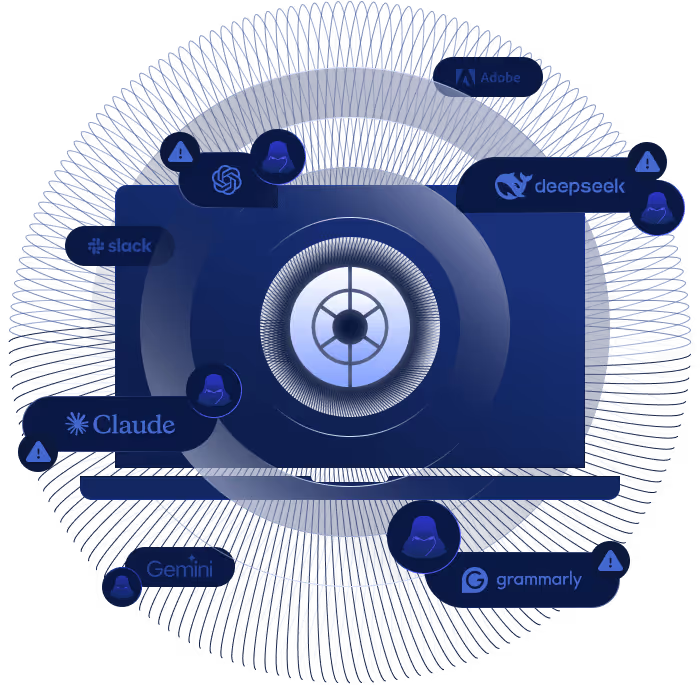
- GenAI security governs four operational layers: shadow AI discovery, prompt-level data inspection, model-connected access governance, and runtime monitoring across SaaS-embedded AI.
- The GenAI threat model diverges from traditional AppSec in fundamental ways: the surface is dynamic, the data layer is the primary target, and outputs can move data without any traditional exfiltration signal.
- GenAI security addresses what humans submit to models and what those models touch on their behalf. Agentic AI security governs what autonomous agents do with the access they inherit. These are sequential, not interchangeable.
- Shadow AI is the prerequisite problem. You cannot govern data flowing into GenAI tools the security team has never reviewed.
- Effective controls require browser-level visibility, not just configuration review or network logging.
The GenAI Security Definition Most Teams Are Using Is Wrong
Security teams managing GenAI deployments in 2026 tend to frame the problem in one of two ways. The first treats it as a subset of general AI security, lumping together model training risks, inference attacks, adversarial examples, and chatbot governance under a single umbrella. The second treats it as a DLP problem: stop employees from pasting sensitive data into ChatGPT, and you have solved it.
Both framings are incomplete, and the gap between them is where real incidents happen.
The DLP-only framing misses the discovery layer entirely. A GenAI tool that the security team has never reviewed cannot be governed by any policy. Browser-level data confirms the scale: nearly 10% of GenAI prompts entered across enterprise environments contain sensitive corporate data, and the apps receiving those prompts include a long tail of tools that bypass corporate SSO entirely.
The "general AI security" framing fails in the opposite direction. It conflates model development concerns, which belong to AI engineering teams, with production deployment concerns, which belong to security teams. A CISO governing a Salesforce deployment with embedded Copilot agents does not need a framework for adversarial machine learning research. They need a framework for what happens when their employees interact with those systems at scale, every day, with real corporate data.
The correct frame is narrower and more operational: GenAI security governs the discovery, data inspection, and access governance of generative AI tools as they operate in production, covering the prompts that reach them, the SaaS connections they hold, and the controls that prevent misuse. That definition has specific components. Knowing them changes how you build your program.
The Security-First Definition of GenAI Security
GenAI security is the practice of protecting enterprise environments where generative AI tools are in use, across four distinct operational layers: discovery, prompt-level data control, model-connected access governance, and runtime monitoring. Each layer carries its own attack surface and requires its own controls.
The Discovery Layer covers identifying every GenAI tool, browser extension, and embedded AI feature that employees are actually using. Shadow AI is the dominant problem at this layer. Tools adopted via personal accounts, browser extensions, and AI features quietly enabled inside trusted SaaS platforms all bypass traditional IT inventory processes. You cannot govern data flowing into GenAI tools that the security team has never reviewed. Shadow AI discovery is the prerequisite, not an optional layer.
The Prompt-Level Data Control Layer covers what employees submit to GenAI tools, before that data leaves the browser. Approximately 10% of GenAI prompts contain sensitive corporate data. Network-layer DLP cannot see prompt content, and email-based monitoring cannot see browser-based AI activity at all. Effective control at this layer requires browser-level inspection that intercepts sensitive prompts before they reach a third-party model. This is the core mechanism behind enterprise prompt security controls.
The Model-Connected Access Governance Layer covers what happens when GenAI tools connect to enterprise systems. A ChatGPT integration with Google Drive, a Copilot agent with a Salesforce connector, or a Notion AI feature with workspace access all introduce a new control plane: the GenAI tool now reaches enterprise data without traveling through a traditional access review process. Excessive OAuth scopes and inherited permissions at this layer routinely exceed what the underlying workflow requires.
The Monitoring Layer covers continuous observation of GenAI usage, data movement, and connected-system activity in production. Static controls at discovery and submission are necessary but insufficient. GenAI tools behave probabilistically. Their outputs shift with context, with user behavior, and with changes to connected data sources. Monitoring is what closes the loop between theoretical configuration and runtime truth.
What this definition includes that most teams miss: the discovery layer is not an IT inventory exercise. When a SaaS vendor quietly enables AI features inside a tool your team already approved, when employees connect ChatGPT to corporate cloud storage, or when a browser extension adds AI capabilities to a sanctioned app, that is a GenAI security event. It belongs in your threat model.
Why GenAI Changes the Threat Model
Traditional application security assumes a deterministic system. A web application receives a request, executes defined logic, and returns a predictable response. The attack surface is the code, the configuration, and the data it touches. You can enumerate it. You can test it. You can reason about it statically.
GenAI breaks every one of those assumptions.
The surface is dynamic. GenAI tools enter the environment through browser extensions, personal account sign-ups, and AI features silently activated inside SaaS apps your organization already trusts. Static asset inventories cannot keep pace. The attack surface today is not the same as the attack surface last quarter.
The data layer is the primary attack target. In traditional AppSec, attackers target code vulnerabilities to reach data. In GenAI environments, the data layer is the attack surface directly. Sensitive prompts entered into unsanctioned tools, corporate documents uploaded for summarization, and meeting transcripts processed by third-party AI all move data outside the organization through channels traditional DLP was never designed to see.
Outputs can move data without traditional exfiltration signals. A GenAI tool that summarizes a contract, drafts an email, or processes a document produces an output that may include sensitive data extracted from source systems. That output looks identical to any other API response at the network layer. The exfiltration is real. The signal is not.
The human-in-the-loop assumption is eroding. Early GenAI deployments kept humans in the loop for every consequential action. In 2026, that assumption is gone for most enterprise deployments. GenAI tools are connected to enterprise systems. They take actions. They move data. The threat model that assumed human review of every output is no longer the operating reality.
Consider a composite scenario that reflects patterns across enterprise deployments: an employee uses an enterprise-connected GenAI assistant to summarize a contract. The assistant, connected to a cloud storage system, surfaces a document the employee was not authorized to see because the model's retrieval configuration did not enforce access controls at the document level. No malicious actor was involved. The model behaved exactly as configured. The configuration was the vulnerability.
Where the threat model still resembles traditional AppSec: authentication, authorization at the API layer, and supply chain integrity for SaaS vendors all map to familiar frameworks. Where it diverges: the surface is dynamic, the data layer is primary, and discovery is a continuous, not point-in-time, control.
The GenAI Attack Surface in Enterprise Environments
What GenAI Security Requires (And Where Agentic AI Security Picks Up)
Effective GenAI security programs operate across four capability layers. These are not sequential stages. They operate in parallel, and gaps in any one layer undermine the others.
Discovery includes browser-level inventory of every GenAI app and extension in use, identification of AI features activated inside trusted SaaS platforms, and continuous surfacing of new tool adoption as it happens. The goal is ensuring that what reaches the prompt layer is something the security team knows about. This is where Obsidian's shadow AI security capability operates.
Prompt-Level Data Control includes real-time inspection of sensitive content before it leaves the browser, blocking or warning on classified data, and enforcement that works for both managed and unmanaged accounts. The goal is ensuring that what reaches a third-party model is policy-aligned. This is where prompt security controls operate.
Model-Connected Access Governance includes inventory of every GenAI-to-SaaS integration, OAuth scope review for AI tool connections, and access right-sizing for the data those integrations can reach. This layer requires collaboration between security teams and the application owners managing the underlying SaaS platforms. It is not optional for organizations running ChatGPT Enterprise, Copilot, Claude, or similar tools with SaaS connectors.
Monitoring includes continuous behavioral observation of GenAI usage across the organization, anomaly detection for unusual prompt or data access patterns, and integration with existing SIEM and SOAR infrastructure. Static controls alone will not hold against tools that change weekly. Monitoring is what converts incidents into detectable events.
These four layers define the GenAI security discipline as it applies to tools interacting with human users.
The agentic shift changes the equation. When a generative model is no longer responding to human prompts but is instead operating as an autonomous agent, taking multi-step actions, calling tools, connecting to APIs, and making decisions without human review, the discipline required expands. The four layers above remain necessary. They become insufficient.
Autonomous AI agents introduce machine insider risk: they hold credentials, inherit permissions, and take actions at machine speed. They can escalate privileges through maker mode configurations, chain actions across multiple systems, and transfer data at up to 16 times the rate of traditional SaaS integrations. The AI agent security discipline picks up where GenAI security ends: governing not what humans submit to models, but what models do with the access they inherit.
The distinction matters for program design. GenAI security controls the human-to-model interaction. Agentic AI security governs the model-to-system interaction. Both are required. Neither substitutes for the other. Understanding what non-human identities are and how they differ from human identities is the foundation for understanding why the agentic discipline requires its own framework, its own controls, and its own visibility layer.
Where GenAI Security Ends, Agentic AI Security Begins
GenAI security is a defined, bounded discipline. It covers four layers: discovery, prompt-level data control, model-connected access governance, and monitoring. It addresses the risks that emerge when generative AI tools operate in production with real users, real data, and real consequences. It is not general AI security, and it is not DLP with a new label.
The threat model GenAI introduces is genuinely different from traditional AppSec: dynamic surfaces, data-layer primacy, output-as-exfiltration vectors, and the erosion of human-in-the-loop assumptions.
Where GenAI security ends, agentic AI security begins. When models become agents, the controls required shift from governing human-to-model interaction to governing model-to-system interaction. That shift introduces machine insider risk, privilege escalation through inherited credentials, and blast radius expansion that no GenAI security framework was designed to address.
Actionable next steps for security teams in 2026:
- Audit your current GenAI controls against all four layers. Most programs have prompt-level controls. Few have mature discovery, model-connected access governance, or monitoring.
- Map your shadow AI exposure. You cannot govern what you cannot see, and at least half of enterprises have shadow AI applications operating outside security oversight.
- Identify where your GenAI deployments have already crossed into agentic territory. If tools are connected to SaaS systems and taking actions on behalf of users, your GenAI security framework is already insufficient.
- Review the AI security across SaaS framework to understand how these disciplines connect in enterprise environments.
Frequently Asked Questions
GenAI security is the practice of protecting enterprise environments where generative AI tools are in use. It covers discovery of every AI tool employees adopt (including shadow AI), inspection of what data flows into those tools, governance of the SaaS connections those tools hold, and continuous monitoring of usage. It is distinct from general AI security, which covers a broader research and engineering scope.
Traditional cybersecurity addresses deterministic systems with enumerable attack surfaces and predictable code paths. GenAI security addresses dynamic environments where new tools enter the surface weekly, where the data layer is the primary attack target, and where outputs themselves can move sensitive data without traditional exfiltration signals. The controls required, the discovery methods, and the monitoring approaches are all fundamentally different.
Shadow AI refers to generative AI applications, browser extensions, and embedded AI features in use across an organization that the security team has not reviewed, approved, or configured. Every shadow AI tool is a gap in your discovery, prompt control, and monitoring layers simultaneously. Effective GenAI security requires continuous discovery of all AI tools in use before any other control is meaningful.
GenAI security governs the human-to-model interaction: what users submit, what models return, the SaaS connections those models hold, and the discovery of every tool in the environment. Agentic AI security governs the model-to-system interaction: what autonomous AI agents do with the access they inherit, how they escalate privileges, how they chain actions across systems, and what data they move at machine speed. GenAI security is necessary but insufficient when models operate as agents.
Traditional DLP tools monitor known channels: email, web upload, endpoint file transfers. GenAI tools operate primarily through browser-based prompts and SaaS API integrations that DLP was not designed to inspect. A sensitive prompt entered directly into ChatGPT, or a document summarized by an AI tool connected via OAuth to corporate Drive, produces no signal in a traditional DLP product. GenAI security requires browser-level inspection and SaaS-layer access governance that traditional DLP cannot provide.