SaaS Supply Chain Security vs Software Supply Chain Security: What CISOs Need to Know
Understand why SaaS supply chain attacks differ from software supply chain risks. Learn how OAuth tokens create breach pathways one integration away.

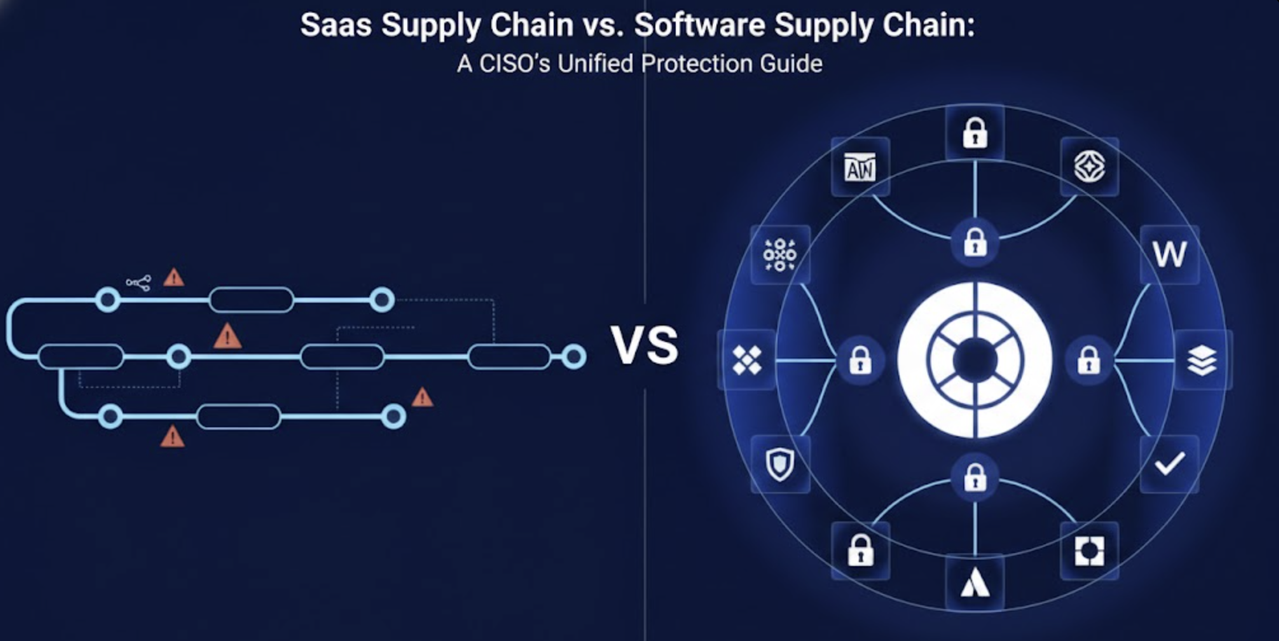
In 2020, attackers compromised SolarWinds' build pipeline and injected malicious code that propagated to 18,000 organizations. Security teams responded with Software Bills of Materials (SBOMs), supply chain frameworks, and pipeline hardening. In 2025, attackers compromised Salesloft's SaaS environment and used OAuth tokens to access 700+ customer Salesforce instances. The mechanism was different. The result was the same: trusted connections became breach pathways.
One supply chain got all the attention. The other operates largely unprotected.
Most organizations believe their biggest supply chain risk lives in their code repositories and build pipelines. In reality, an equally dangerous exposure sits one integration away, hidden in the OAuth tokens and API connections that link their SaaS applications. Understanding SaaS Supply Chain Security vs Software Supply Chain Security: What CISOs Need to Know is no longer optional when attackers exploit both attack surfaces with equal efficiency.
The numbers tell a stark story. Open-source malware detections surged 73% in 2025 compared to the prior year, highlighting escalating risks in the software supply chain. Meanwhile, 15% of all SaaS breaches now originate from third-party or supply chain compromise, with organizations experiencing an average cost of $4.91 million per breach. Yet 86% of organizations treat SaaS security as a high priority, with 76% increasing security budgets to address these blind spots.
Key Takeaways
- Two distinct supply chains require different security approaches: Software supply chain attacks target code pipelines and dependencies, while SaaS supply chain attacks exploit OAuth tokens and integration trust relationships.
- Attack speed differs dramatically: Software supply chain compromises propagate through deployment cycles (days to weeks), while SaaS supply chain breaches spread instantly through existing token access.
- Visibility gaps create detection failures: SBOMs reveal software components but miss runtime behavior; integration inventories list connections but lack behavioral context for detecting abuse.
- Remediation strategies diverge: Software supply chain incidents require patching and redeployment, while SaaS breaches demand immediate token revocation and integration isolation.
- CISOs need unified governance: Protecting both supply chains requires coordinated discovery, assessment, monitoring, and response capabilities tailored to each attack vector.
What Is Supply Chain Security?
Supply chain security protects not just your systems, but everything connected to them. The fundamental challenge remains constant across domains: attackers target the weakest link in the chain of trust. When you cannot secure every component directly, you must govern the relationships between them.
The "weakest link" problem manifests differently depending on the supply chain. In software development, a single compromised dependency can affect thousands of downstream applications. In SaaS environments, a single compromised vendor integration can provide immediate access to sensitive data across multiple customer tenants.
Understanding SaaS Supply Chain Security vs Software Supply Chain Security: What CISOs Need to Know begins with recognizing these as two distinct attack surfaces with different threat models, different attack vectors, and different control requirements.
Software Supply Chain Security: The Code Pipeline
Definition and Scope
Software supply chain security focuses on protecting software development and delivery infrastructure. This includes code repositories, open-source dependencies, build systems, and deployment pipelines. The attack surface extends from the moment code is written through compilation, testing, packaging, and distribution.
The shared responsibility model in software supply chain security places significant control in the hands of development teams. Organizations can implement code review processes, dependency scanning, and build verification. However, they inherit risk from every upstream dependency and development tool in their stack.
Components Under Protection
Software supply chain security encompasses six critical components:
- Source code and version control systems where developers commit changes and collaborate
- Open-source dependencies and libraries that provide reusable functionality
- Build systems and CI/CD pipelines that compile, test, and package software
- Package registries and artifact repositories that distribute compiled software
- Development tools and IDEs that developers use to write code
- Testing and deployment infrastructure that validates and releases software
Each component represents a potential compromise point. Attackers who infiltrate any layer can inject malicious code that propagates to all downstream consumers.
Attack Vectors and Techniques
Software supply chain attacks exploit trust relationships between developers, dependencies, and build systems. Common attack vectors include:
Dependency confusion and typosquatting trick build systems into downloading malicious packages with names similar to internal dependencies. Attackers register public packages that shadow private package names, exploiting misconfigured package managers.
Compromised open-source packages occur when attackers gain maintainer access to legitimate libraries and inject malicious code into trusted updates. The xz Utils backdoor attempt in 2024 demonstrated how years-long social engineering can position attackers to compromise widely-used software.
Build system infiltration allows attackers to modify compilation processes and inject code without touching source repositories. The SolarWinds breach exemplified this technique, where attackers compromised build servers to inject malicious code during the compilation process.
Code signing certificate theft enables attackers to sign malicious software with legitimate certificates, bypassing security controls that verify publisher identity. The 3CX attack in 2023 used stolen certificates to distribute trojanized software updates.
Pipeline injection attacks exploit weaknesses in CI/CD configurations to execute malicious code during automated builds. Attackers manipulate environment variables, build scripts, or deployment configurations to achieve code execution.
Notable Software Supply Chain Attacks
SolarWinds (2020) remains the defining software supply chain incident. Attackers compromised build infrastructure and injected malicious code into the Orion platform, affecting approximately 18,000 organizations. The breach went undetected for months, demonstrating the stealth potential of supply chain attacks.
Log4j (2021) exposed how a vulnerability in a ubiquitous library can create industry-wide impact. The remote code execution flaw affected millions of applications, requiring emergency patching across entire technology stacks.
3CX (2023) showed how software supply chain attacks can cascade. Attackers compromised the 3CX desktop application, which then served as a delivery mechanism for additional malware, creating a multi-stage supply chain compromise.
xz Utils (2024) revealed the sophistication of modern supply chain attacks. An attacker spent years building trust in the open-source community before attempting to backdoor a compression library used across Linux distributions.
Solutions and Frameworks
Organizations defend software supply chains through multiple layers:
Software Composition Analysis (SCA) tools scan codebases to identify open-source dependencies and known vulnerabilities. These tools provide visibility into what components exist in your software but struggle to assess runtime behavior.
Software Bill of Materials (SBOM) documents all components in a software package, creating transparency about dependencies. CISA released updated SBOM minimum elements in February 2025, introducing mandatory fields like Tool Name, License, and Component Hash to standardize software supply chain transparency.
SLSA framework (Supply-chain Levels for Software Artifacts) provides graduated security levels for build integrity. Organizations implement SLSA requirements to verify that software artifacts are built securely and haven't been tampered with.
Code signing and verification ensures software comes from trusted publishers and hasn't been modified. However, certificate theft attacks demonstrate that signing alone doesn't guarantee security.
Pipeline security hardening locks down build environments, restricts access, and implements verification at each stage. This includes secrets management, build isolation, and artifact validation.
For organizations looking to strengthen their overall security posture, understanding what is SaaS security provides essential context for protecting modern cloud environments.
SaaS Supply Chain Security: The Integration Layer
Definition and Scope
SaaS supply chain security protects the connections between SaaS applications through OAuth tokens, API integrations, third-party apps, and vendor relationships. Unlike software supply chain security, which focuses on code integrity, SaaS supply chain security addresses trust delegation and data access governance.
The attack surface in SaaS supply chains is fundamentally different. Organizations don't control vendor security posture, can't inspect vendor code, and often lack visibility into how integrations actually behave after authorization. Security teams must govern relationships they cannot directly secure.
Components Under Protection
SaaS supply chain security encompasses six critical areas:
- SaaS vendors and their security posture, including their own supply chain dependencies
- OAuth tokens and API integrations that enable application-to-application communication
- SaaS-to-SaaS connections that create data flows between platforms
- Third-party apps and plugins that extend core SaaS functionality
- Shadow SaaS and unauthorized integrations that bypass IT approval processes
- AI/LLM integrations and Model Context Protocol (MCP) connections that request broad permissions to operate autonomously
Each component extends your trust boundary beyond direct control. When you authorize an OAuth integration, you delegate access to a third party whose security practices may not match your own standards.
Attack Vectors and Techniques
SaaS supply chain attacks exploit the trust inherent in authorized integrations. Attackers don't need to break authentication when they can abuse existing access.
OAuth token theft and abuse provides attackers with legitimate credentials that bypass MFA and SSO controls. Most SaaS apps implement OAuth tokens as bearer tokens, something like a key. Whoever has this key can use it, regardless of how they obtained it. Refresh tokens are especially risky because they operate outside traditional login flows and can persist for months or years.
Third-party application compromise occurs when attackers breach a SaaS vendor and leverage customer OAuth tokens to access downstream systems. The Salesloft-Drift incident demonstrated this attack path, where compromised vendor infrastructure provided access to customer Salesforce environments.
Vendor breach propagation happens when a security incident at one SaaS provider cascades to connected applications. Attackers replay tokens, move laterally across connected SaaS applications, and access sensitive data without triggering traditional security alerts.
Over-privileged integration access creates toxic combinations where integrations request and receive far more permissions than necessary. According to Obsidian's network data, integrations increased 120% year-over-year in Microsoft environments alone, with many maintaining admin-level access to sensitive data.
Consent phishing attacks trick users into authorizing malicious OAuth applications that appear legitimate. Once authorized, these applications gain persistent access to user data and can operate independently of the user's session.
Refresh token persistence allows attackers to maintain access even after password resets or session terminations. Because refresh tokens operate outside normal authentication flows, traditional security controls often miss their abuse.
Notable SaaS Supply Chain Attacks
Salesloft-Drift (2025) exposed the cascading impact of SaaS supply chain breaches. Attackers compromised Salesloft's environment and used OAuth tokens tied to the Drift integration to access more than 700 customer Salesforce instances. They systematically exported sensitive data from customer contacts to credentials like AWS keys and Snowflake tokens. The breach went undetected until vendor disclosure, leaving customers scrambling to assess impact with limited visibility.
Mimecast/SolarWinds (2021) showed how OAuth certificate compromise enables email access. Attackers stole a certificate used for Microsoft 365 integration, providing access to customer email environments through a trusted connection.
Snowflake Campaign (2024) demonstrated credential stuffing at scale against SaaS data warehouses. Attackers targeted 165+ customer environments, exploiting weak authentication and lack of MFA to access sensitive data. The incident highlighted how SaaS platforms often treat security as secondary.
Waydev (2020) involved OAuth token theft from a development tool integration. Attackers gained access to source code repositories through compromised OAuth tokens, demonstrating how development tool integrations create hidden attack paths.
For teams managing these risks, understanding OAuth security best practices is essential.
Solutions and Frameworks
Organizations defend SaaS supply chains through specialized capabilities:
SaaS Security Posture Management (SSPM) provides continuous visibility into SaaS configurations, user permissions, and integration access. SSPM solutions discover OAuth tokens, assess risk, and monitor for configuration drift.
Third-Party Risk Management (TPRM) evaluates vendor security posture through questionnaires, certifications, and assessments. However, traditional TPRM provides limited visibility into internal data and only captures static snapshots, missing critical details about integrations, tokens, and permissions.
OAuth token discovery and governance inventories every OAuth application, API integration, and service account with access to SaaS data. This includes shadow OAuth tokens created without IT approval and stale integrations with over-privileged access.
Behavioral detection and monitoring identifies when trusted integrations deviate from normal patterns. Unlike static inventory tools, behavioral detection spots abuse the moment integrations start acting like threats, before vendor breach notifications arrive.
Integration inventory and lifecycle management tracks integration creation, permission changes, and usage patterns over time. This operational visibility enables teams to enforce least privilege and remove risky connections before they escalate into breaches.
Organizations seeking comprehensive protection should explore SaaS security best practices that address both posture management and threat detection.
Key Differences: SaaS vs Software Supply Chain Security
Understanding SaaS Supply Chain Security vs Software Supply Chain Security: What CISOs Need to Know requires recognizing how these domains diverge across critical dimensions:
Dimension Software Supply Chain SaaS Supply Chain Primary Attack Vector Malicious code injection Token/credential theft Entry Point Build pipeline, dependencies OAuth grants, API integrations Visibility Tool SBOM OAuth/integration inventory Control Point Code review, build security Vendor trust, token governance Remediation Patch, update, rebuild Revoke, disconnect, rotate Framework SLSA, NIST SSDF TPRM, SSPM Primary Tool SCA, SAST SSPM, CASB Attack Speed Slow (requires deployment) Fast (immediate token access) Persistence Embedded in code Token-based (revocable) Blast Radius All software consumers All connected SaaS apps
Attack Vector: Code vs. Tokens
Software supply chain attacks require attackers to inject malicious code and wait for deployment cycles to propagate the compromise. The attack unfolds over days or weeks as organizations build, test, and deploy affected software. Detection often occurs during code review, vulnerability scanning, or post-deployment monitoring.
SaaS supply chain attacks provide immediate access through stolen or abused tokens. An attacker with a valid OAuth refresh token can access data instantly, without waiting for deployment cycles or triggering authentication alerts. The attack speed is fundamentally different because the access mechanism already exists.
This speed differential has major implications for detection and response. Software supply chain compromises leave forensic evidence in build logs, code commits, and deployment artifacts. SaaS supply chain breaches often blend into normal API activity, making them harder to distinguish from legitimate business operations.
Visibility: SBOM vs. Integration Inventory
Software Bill of Materials (SBOM) documents every component in a software package, creating transparency about dependencies. However, SBOMs capture static composition, not runtime behavior. They tell you what libraries exist in your code but not how those libraries behave when executed or whether they've been compromised since the SBOM was generated.
Integration inventories list OAuth applications, API connections, and service accounts with access to SaaS data. Like SBOMs, these inventories provide point-in-time visibility but miss usage patterns and behavioral anomalies. An integration inventory shows that Salesloft has access to Salesforce, but not that it's suddenly exporting customer data at 3 AM.
Both approaches share a fundamental limitation: they provide composition visibility without behavioral context. Knowing what's connected matters less than understanding how connections behave.
Control: Build vs. Trust
Software supply chain control centers on build pipeline security. Organizations can implement code review processes, dependency scanning, build verification, and artifact signing. While you inherit risk from upstream dependencies, you control the compilation and deployment process.
SaaS supply chain control requires trust delegation. When you authorize a third-party OAuth application, you grant access to a vendor whose security practices you cannot directly control. You can assess vendor posture through questionnaires and certifications, but you cannot inspect their code, audit their infrastructure, or verify their security controls.
This trust delegation creates asymmetric risk. A software supply chain compromise requires attackers to infiltrate your build environment or an upstream dependency. A SaaS supply chain compromise only requires attackers to breach one vendor you've authorized, then leverage existing OAuth tokens to access your environment.
Remediation: Patch vs. Revoke
Software supply chain remediation follows a traditional patch management cycle: identify affected versions, test patches, schedule maintenance windows, deploy updates, and verify fixes. The process takes days or weeks, depending on change management requirements and deployment complexity.
SaaS supply chain remediation can happen instantly through token revocation. Once you identify a compromised integration, you can revoke OAuth tokens immediately, cutting off attacker access without waiting for deployment cycles or vendor patches.
However, this speed advantage assumes you can find all affected tokens. Without comprehensive visibility into OAuth grants and integration relationships, organizations struggle to identify which tokens to revoke and which systems might be affected. The Salesloft-Drift incident left customers manually searching logs and reconstructing access paths under intense pressure.
Propagation Speed: Deployment vs. Immediate
Software supply chain attacks propagate through deployment cycles. When SolarWinds released a compromised update, it took days to weeks for organizations to deploy the malicious version. This deployment lag provided a window for detection, though most organizations missed it.
SaaS supply chain attacks propagate instantly through existing token access. The Salesloft-Drift breach affected 700+ organizations immediately because the OAuth tokens were already authorized and active. There was no deployment cycle, no update process, and no opportunity to intercept the compromise before it reached customer environments.
This propagation speed makes early detection critical. By the time vendors disclose a breach, attackers have often completed data exfiltration across hundreds of customer tenants.
Why CISOs Need Both Perspectives
The Converging Threat Landscape
Attackers don't limit themselves to one supply chain. The 3CX attack demonstrated how software supply chain compromise can progress into SaaS environments. Attackers compromised 3CX's desktop application (software supply chain), which then provided access to customer credentials and cloud resources (SaaS supply chain).
As organizations adopt AI agents and autonomous systems, the boundaries blur further. AI tools request OAuth access to multiple SaaS applications simultaneously, creating new attack paths that combine software and SaaS supply chain risks. According to 2026 security trends, OAuth abuse and non-human identities with excessive access are emerging as critical vulnerabilities, particularly as AI tools gain default access to sensitive data through overly broad permissions.
Comprehensive protection requires addressing both attack surfaces with appropriate tools and processes.
Shared Principles, Different Operations
Both supply chains require the same fundamental capabilities:
Discovery of all components and connections
Assessment of risk based on permissions, behavior, and vendor posture
Continuous monitoring for anomalies and indicators of compromise
Governance through approval workflows and least privilege enforcement
However, the operational implementation differs significantly. Software supply chain discovery uses SCA tools and SBOM generation. SaaS supply chain discovery requires OAuth token enumeration and integration mapping. The principles align, but the tools and techniques diverge.
Both domains face visibility gaps, governance challenges, and detection difficulties. Both struggle with the operational burden of manual tracking and spreadsheet inventories. Both need behavioral context to distinguish legitimate activity from abuse.
Board-Level Risk Narrative
When CISOs present supply chain risk to boards, conversations often focus exclusively on software supply chain threats. The SolarWinds breach created awareness about build pipeline security, dependency management, and code integrity.
SaaS supply chain risk receives less attention despite comparable impact. The Salesloft-Drift breach affected 700+ organizations, but didn't generate the same board-level urgency as SolarWinds. This perception gap creates funding and prioritization challenges for SaaS security initiatives.
CISOs need language to explain both risks clearly:
Software supply chain risk: "Attackers can inject malicious code into our software dependencies, affecting every system that uses those components. We address this through SBOMs, dependency scanning, and build verification."
SaaS supply chain risk: "Attackers can compromise our SaaS vendors and use existing OAuth tokens to access our data immediately, bypassing MFA and traditional controls. We address this through integration governance, behavioral monitoring, and vendor risk assessment."
Both narratives deserve equal attention in risk discussions and budget allocation.
For organizations building comprehensive security programs, exploring SaaS security trends for 2026 provides strategic context for emerging threats.
Building a Unified Supply Chain Strategy
Assessment Phase
Effective supply chain security begins with comprehensive discovery across both domains:
Software supply chain assessment:
- Implement SBOM generation for all deployed applications
- Catalog open-source dependencies and their versions
- Map build pipeline components and access controls
- Identify critical software assets and data flows
- Document single points of failure in development infrastructure
SaaS supply chain assessment:
- Discover all OAuth tokens, API integrations, and service accounts
- Inventory third-party apps and browser extensions
- Map SaaS-to-SaaS connections and data flows
- Identify shadow SaaS and unauthorized integrations
- Document critical SaaS assets and sensitive data locations
Unified assessment:
- Map data flows across both software and SaaS environments
- Identify assets that span both domains (e.g., CI/CD tools with SaaS integrations)
- Assess vendor security posture for both software and SaaS providers
- Document acceptable risk thresholds for each supply chain type
Organizations can leverage free risk assessments to understand their SaaS integration exposure.
Governance Phase
Governance frameworks must address both supply chains while recognizing their operational differences:
Software supply chain governance:
- Implement dependency approval workflows before adoption
- Establish version pinning and update policies
- Define acceptable licenses and security requirements
- Create exception processes for critical dependencies
- Document vendor security assessment criteria
SaaS supply chain governance:
- Implement integration approval workflows before OAuth grants
- Establish least privilege principles for API scopes
- Define acceptable vendor security postures
- Create processes for shadow SaaS discovery and remediation
- Document integration lifecycle management procedures
Unified governance:
- Apply consistent vendor security assessment criteria across domains
- Define risk tolerance thresholds that span both supply chains
- Establish cross-functional approval processes
- Create unified exception management
- Document escalation paths for high-risk scenarios
Configuration drift and undocumented changes in SaaS platforms represent a distinct control gap, requiring continuous monitoring rather than periodic checks to maintain compliance and security posture.
Monitoring Phase
Continuous monitoring provides early warning of supply chain compromise:
Software supply chain monitoring:
- Vulnerability scanning for known CVEs in dependencies
- Dependency update tracking and version monitoring
- Build pipeline integrity verification
- Code signing validation
- Threat intelligence correlation for software vulnerabilities
SaaS supply chain monitoring:
- OAuth token behavior analysis for anomalies
- Integration activity monitoring for unusual patterns
- Permission change detection and alerting
- Data access anomaly identification
- Vendor breach notification tracking
Unified monitoring:
- Anomaly detection across both software and SaaS environments
- Threat intelligence correlation spanning both domains
- Vendor breach notification processes for all providers
- Cross-domain attack path analysis
- Behavioral baseline establishment for normal operations
The detection gap in SaaS supply chain security remains significant. While software supply chain vulnerability scanners detect known issues, no equivalent exists for SaaS behavioral anomalies. When your vendor is breached, how do you know before the disclosure arrives?
Response Phase
Incident response playbooks must account for the different remediation timelines:
Software supply chain response:
- Patching playbooks with testing and deployment procedures
- Rollback procedures for compromised updates
- Build environment isolation and forensics
- Dependency replacement workflows
- Customer notification for affected software
SaaS supply chain response:
- OAuth token revocation playbooks with immediate execution
- Integration isolation procedures to contain blast radius
- Data access forensics across connected SaaS apps
- Vendor communication protocols during active incidents
- Customer notification for data exposure
Unified response:
- Cross-domain incident correlation procedures
- Vendor communication protocols applicable to both domains
- Customer notification templates for supply chain incidents
- Post-incident review processes
- Lessons learned integration into governance
Organizations managing complex SaaS environments should review breach containment best practices to prepare for supply chain incidents.
The Detection Gap in SaaS Supply Chain Security
Software supply chain security benefits from mature detection capabilities. Vulnerability scanners identify known CVEs in dependencies. SBOM analysis reveals outdated components. Build verification detects pipeline tampering. These tools provide reasonable coverage for known threats.
SaaS supply chain security lacks equivalent detection capabilities. Traditional security tools monitor endpoints and users, while SaaS-to-SaaS access between applications operates quietly in the background. OAuth tokens function independently of SSO and MFA, creating an invisible layer where attackers can operate undetected.
When your vendor is breached, how do you know? Most organizations discover SaaS supply chain compromises through vendor disclosure, not internal detection. By that time, attackers have often completed data exfiltration across multiple customer environments.
What Behavioral Detection Provides
Behavioral detection addresses this gap by monitoring how integrations actually behave:
Token usage patterns that indicate compromise, such as access from unexpected locations, unusual API call volumes, or activity outside normal business hours
Integration behavior changes after vendor incidents, including new data access patterns, permission escalations, or lateral movement to connected applications
Data access anomalies suggesting exfiltration, such as bulk downloads, systematic enumeration of sensitive records, or access to data outside the integration's normal scope
Early warning signals before breach notifications arrive, providing time to investigate, contain impact, and protect data before widespread exploitation
This behavioral approach complements traditional posture management. While SSPM tools inventory integrations and assess configurations, behavioral detection identifies when those integrations start acting like threats.
According to Obsidian's network data, organizations that implement behavioral monitoring detect supply chain compromises an average of 14 days earlier than those relying solely on vendor notifications. This detection window makes the difference between contained incidents and cascading breaches.
Conclusion
SaaS Supply Chain Security vs Software Supply Chain Security isn't an either/or decision. Both supply chains require protection, but they demand different tools, different processes, and different operational approaches.
Your software supply chain has SBOMs, SCA tools, and pipeline security. Your SaaS supply chain has manual spreadsheets and hope. This asymmetry creates risk.
The Salesloft-Drift breach demonstrated what happens when SaaS supply chain security lags behind software supply chain maturity. Seven hundred organizations discovered they had blind spots in their integration security only after receiving vendor breach notifications. By then, attackers had already accessed Salesforce data, exported sensitive information, and moved laterally to connected systems.
CISOs must build unified supply chain strategies that address both attack surfaces:
Discover all components and connections across software and SaaS domains
Assess risk using appropriate frameworks for each supply chain type
Monitor continuously for both known vulnerabilities and behavioral anomalies
Respond with playbooks tailored to each domain's remediation timeline
Govern through consistent principles applied with domain-specific controls
The convergence of AI, SaaS integrations, and autonomous agents will only increase supply chain complexity. Organizations that build comprehensive visibility and governance now will be positioned to secure emerging attack surfaces. Those that focus exclusively on software supply chain security while ignoring SaaS integration risks will continue discovering breaches through vendor notifications.
Take Action
Assess your SaaS supply chain visibility today. Obsidian discovers every OAuth token and integration in your SaaS environment, monitors behavior for anomalies, and alerts when trusted connections start acting like threats. See your SaaS supply chain risk before your vendor's breach notification arrives
For the program side, see third-party risk management in the AI era.