Head-to-Head

Reco vs. Obsidian

Reco shows what's connected. Obsidian shows what each connection actually did, with the activity evidence to act.

Trusted By

Reco is a mile wide and an inch deep. They'll claim 200+ apps, but real analytics only exist for a small subset."

— Security Leader, Fortune 50 Bank

Why Obsidian beats Reco

Know how access is actually used

Reco surfaces which SaaS apps and OAuth integrations exist in your environment. Obsidian shows what each identity and integration actually did, when, and what data they touched. One maps the surface. The other shows the activity underneath.

See the real SaaS supply chain risk, not just the OAuth list

Reco inventories which integrations are connected and the scopes they hold. Obsidian traces what each integration actually accessed, who it affected, and where the blast radius landed. The difference between knowing an integration exists and knowing whether it's a problem.

Connectors built for production scale

Reco's low-code "SaaS App Factory" prioritizes connector breadth. In one Fortune 50 insurer environment, that design generated nearly 20x more Okta API calls per day than Obsidian. Avoidable load on the SaaS systems your business runs on.

Reco vs. Obsidian

Least privilege icon
Posture with evidence
SaaS supply chain
AI agent security
Connector design
Investigation depth
Reco
Surfaces which configurations and permissions are risky
Inventories OAuth integrations and SaaS-to-SaaS connections
Recent platform repositioning: agent inventory, ownership, access mapping across 225+ apps
"SaaS App Factory" prioritizes coverage breadth; API volume against enterprise apps can run significantly higher
Dashboards and visualization for surface-level review; custom investigations and alerting capped
Identity-linked activity evidence tied to each posture finding, with proof app owners can act on
Traces what each integration accessed, who it affected, and the blast radius across the SaaS stack
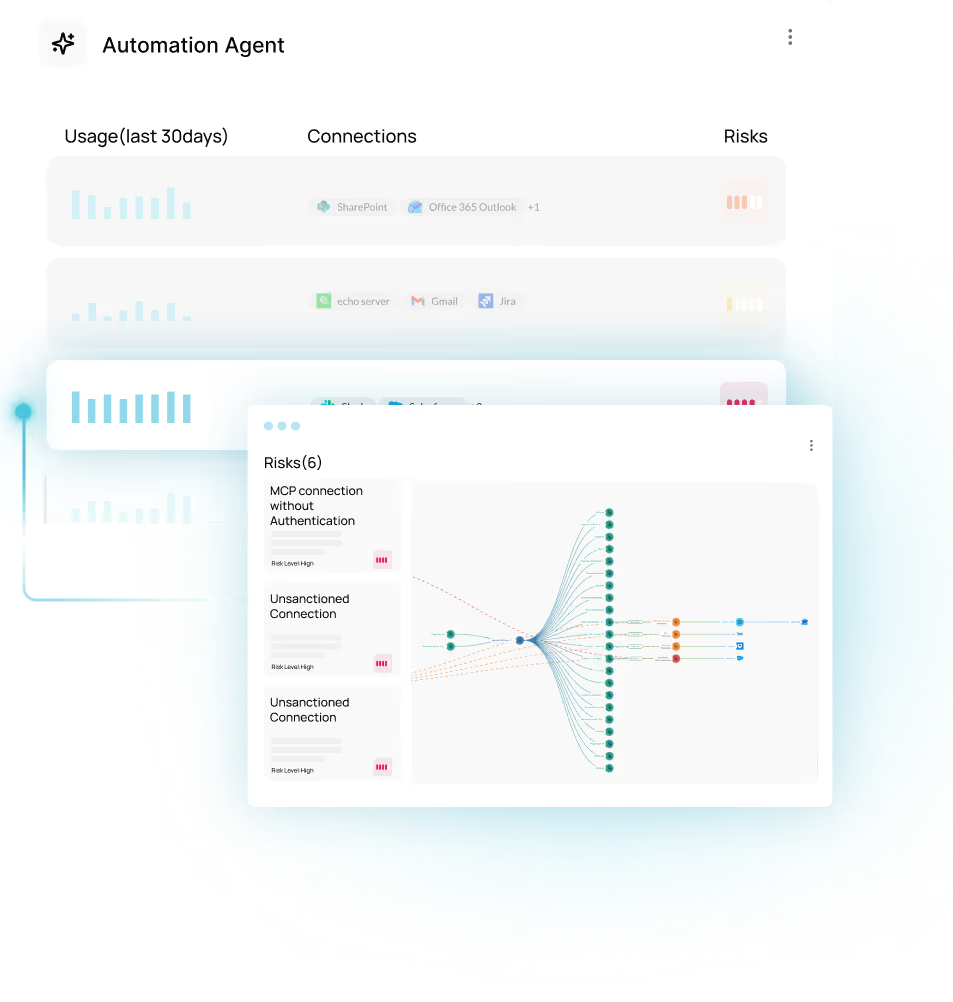
Native SaaS activity behind every agent: what each agent's credentials actually reach inside the connected apps, who can invoke it, and what it did at runtime
Production-safe connectors with bulk API support, granular RBAC scoped per app, 99.99% uptime
OQL queries return investigation-ready answers in minutes, with customizable detections and activity-based hunts

Deep SaaS integrations that show real risk

Two different approaches

Reco's bet is connector breadth: the "SaaS App Factory" expands the connector list quickly, with dashboards and visualization layered on top. Coverage volume, with depth varying by app.

Obsidian secures SaaS and AI as one system. It combines SSPM, SaaS Supply Chain Resilience, AI Security Posture Management, and Identity Threat Detection and Response in a single platform, with the visibility, runtime protection, and continuous governance to act across every application, agent, and integration. The bet is enterprise-grade depth: production-safe connectors, identity-linked evidence behind every finding, and detection models tuned on real incident response work.

Reco maps the surface. Obsidian shows the activity underneath.

Why it matters

Visibility without depth fills your queue with findings you can't validate, integrations you can't investigate, and agents you can't audit at runtime. Obsidian's behavioral detections are tuned on 500+ real SaaS incident response engagements, so the signal you're acting on was earned in production. The breach surface lives where the activity is, not where the inventory ends.
FAQs

We need fast, broad SaaS coverage. Why isn't Reco the easier path?

Speed of coverage and depth of coverage aren't the same thing. Reco's low-code model puts a name onto the connector list quickly, but the analytics behind each name vary widely. Obsidian's connectors are enterprise-grade across the apps that matter most: Salesforce, Workday, M365, the IdPs, the AI platforms. Fast coverage on apps you can't investigate doesn't shorten the work. It just moves it downstream.

What about Reco's app-to-app and OAuth visualization?

Mapping which integrations exist is the starting point. Obsidian traces what each integration actually accessed, who triggered it, and where the impact landed. In one global insurer environment running both platforms, Reco showed a malicious Salesforce Data Loader integration was connected. Obsidian identified it as compromised and defined the blast radius. As one Obsidian customer running a Reco side-by-side put it: "at least you guys have the data, you can mature it." The underlying activity model is the moat.

Reco recently repositioned as an AI agent security platform. How is Obsidian different?

Reco's repositioning is around agent inventory, ownership, and access mapping across 225+ apps. That's the surface. The bedrock is what those agents are actually doing inside the connected SaaS apps. Agents authenticate through OAuth tokens and service accounts that reach into Salesforce, Workday, M365, and the rest. The toxic combination (what each agent's credentials reach inside those apps, who can invoke it, what data moved when it ran) forms in the SaaS layer, not the agent layer. Without native SaaS activity, an AI agent platform inventories agents but doesn't see what they're doing. Full argument in The Architecture Gap No AI Agent Security Tool Is Built to Close.

Is Obsidian built for regulated, global environments?

99.99% uptime over the last 12 months. Regional hosting across the US, Europe, Saudi Arabia, and Australia. Granular RBAC scoped per app. Production-safe connectors with bulk-API support. Obsidian connects to your most critical SaaS apps and collects activity data without disrupting them. Learn more about our certifications and attestations.

Where do these insights come from?

These aren't AI-generated summaries. They come from real customers — including Fortune 100 and Global 2000 environments — where Obsidian and Reco were evaluated head-to-head.

Ready to see the difference yourself?

See what gives Obsidian the edge over others

Request a demo