AI Agent Blast Radius: Containment and Reduction Strategies
Blast radius is the real measure of agent risk, defined by what one agent can reach at runtime rather than what its configuration claims.
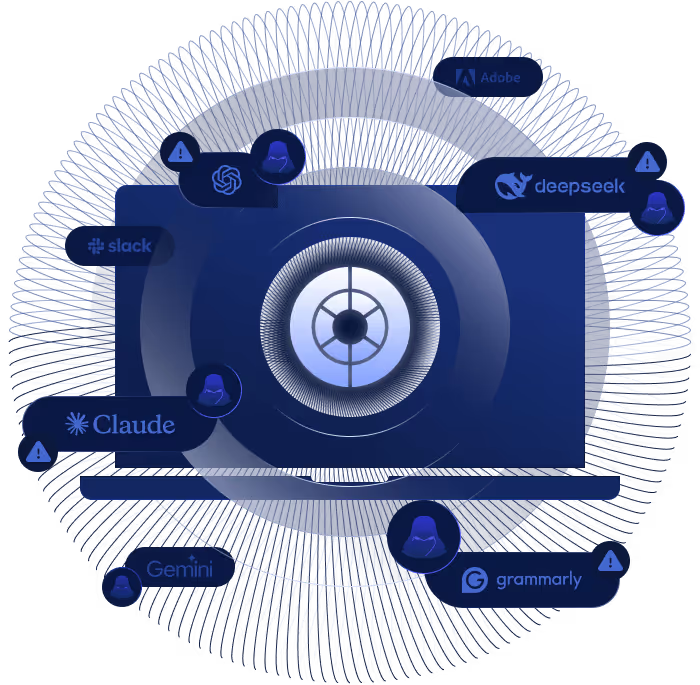
Blast radius is the scope of data, systems, and downstream actions one agent can reach given its effective authority, not its theoretical configuration. - Maker mode credentials expand blast radius fastest, because any invoker inherits the creator's admin-level access. - Action chaining compounds reach with every tool call. AI agents move roughly 16x more data than humans, so a single bad chain moves a lot before anyone notices. - Configuration reviews cannot contain blast radius. Only runtime truth shows what an agent actually did. - Roughly 90% of agents are over-permissioned, which makes least privilege at runtime the first reduction lever worth pulling. - Deterministic guardrails for probabilistic agents cut off dangerous action paths before they complete, where after-the-fact logging cannot.
What Is AI Agent Blast Radius?
AI agent blast radius containment is the practice of limiting how much damage a single agent can cause when it is compromised, misconfigured, or manipulated. Blast radius itself is the total scope of that damage: every record the agent can read, every action it can execute, every downstream system it can trigger, and every other agent it can call. If you want one number that predicts how bad an agentic incident gets, blast radius is that number.
Data reach and action reach
Two dimensions define the blast radius of any agent.
- Data reach is which records, files, and knowledge bases the agent can read.
- Action reach is which systems the agent can write to, modify, or trigger, including other agents.
Both must be measured against the agent's effective authority rather than its theoretical configuration. An agent configured for a narrow task can still hold wide reach through inherited tokens and connected tools.
Why cloud blast radius models break
The concept comes from cloud security, where a compromised IAM role could only touch the resources it was scoped to. Agents break that assumption. An agent carries bearer tokens, inherits creator credentials, and chains actions across applications in seconds. What the configuration says the agent can do and what the agent can actually execute at runtime are frequently two different things. That gap is where blast radius lives.
What Expands an AI Agent's Blast Radius?
Blast radius grows when an agent's runtime authority exceeds the invoker's authority, when actions chain across systems, or when identity boundaries collapse. Five mechanisms drive most real-world expansion.
Maker mode credentials
When an admin builds an agent in maker mode, the agent runs with the creator's credentials, not the invoker's. Any user who talks to that agent inherits the maker's access. A user with no CRM license can pull CRM records, because the agent's embedded credentials belong to an administrator. Your identity controls did nothing wrong. They were bypassed.
Action chaining
Action chaining is the sequence of tool calls an agent makes to finish a task, and each call compounds reach. An agent reads from a document store, writes to a shared doc, posts to a chat channel, then fires a workflow that pushes data to a public endpoint. Each hop looks legitimate alone. Together they carry sensitive data past the trust boundary at machine speed.
Over-permissioned service accounts
Roughly 90% of agents hold more access than their workflow needs. A cloud-hosted agent granted full account read, another with wide storage-bucket access, a productivity agent inheriting a power user's full directory permissions: each one is a blast radius multiplier waiting for an incident.
Agent-to-agent reach
Multi-agent setups add a new expansion path. Agent A has narrow permissions. Agent B has broad permissions. Agent A calls Agent B and receives data it should never have reached. This is the confused deputy problem at scale, because agents trust each other's tokens without checking the original invoker's authority.
Shadow MCP connections
MCP servers connect agents to tools, files, and external services. Shadow MCP servers, meaning unsanctioned and unmanaged ones, attach to agents outside any inventory. Every tool hidden inside such a server is a new action the agent can take, and those tools are visible only at runtime. Static configuration reviews miss them.
How to Measure and Map Blast Radius
You cannot limit AI agent blast radius that you cannot see. Measurement comes before any control, and it has three parts: find the agents, resolve their real authority, then score the combinations that turn a medium risk into a critical one.
Inventory every agent, everywhere
Start with a full count across every platform in use, sanctioned and shadow. Agents built in different tools, embedded in workflows, or spun up by individual teams all count. An agent with no owner and no inventory record is the one that will surprise you.
Map effective authority, not theoretical configuration
For each agent, correlate four things: the agent's identity, the invoker's identity, the tokens in use, and the actual entitlements inside each connected app. Two agents with identical setups can hold very different effective authority once inherited entitlements resolve. Only runtime truth reconciles the two.
Score toxic combinations
A single high-severity factor is manageable. The danger is stacking. A shadow agent with org-wide access to sensitive data reaches critical severity even when each factor alone scored medium. Rank agents by these combinations so remediation starts where blast radius is largest.
AI Agent Blast Radius Containment Strategies
Containment splits into two jobs: stopping an incident already in progress, and building the standing controls that keep any future incident small. Both aim to contain agentic AI blast radius before it becomes an enterprise event.
Contain an agent that has gone rogue
An in-progress incident needs three moves in order: revoke identity, cut tool access, then investigate. Investigating first lets action chaining keep running.
- Revoke tokens and OAuth grants across every connected app, and rotate any shared or maker mode credentials the agent inherited.
- Disable the agent at the platform layer. Suspend it, do not just unpublish.
- Sever MCP server connections the agent relied on, especially unauthenticated ones.
- Trace action history across every system the agent touched, using runtime evidence rather than configuration snapshots.
- Identify downstream agents that inherited context or data from the compromised one.
An agent that has gone rogue is rarely malicious. Usually it was manipulated, invoked by an unauthorized user, or ran an unintended chain. Runtime evidence tells you which.
Sandbox at the identity layer
Process isolation and container boundaries protect the runtime host, but an agent's real reach is its identity, not its process. Sandboxing that matters:
- Dedicated service accounts per agent with narrowly scoped entitlements.
- Environment separation so non-production agents never hold production credentials.
- Network segmentation limiting which APIs and MCP servers the agent can reach.
- Sensitive data class restrictions using platform-native labels.
- Human checkpoints for high-severity actions such as deletion, external sharing, or payments.
Set resource limits
Resource limits put a ceiling on how much a runaway session can move before human review. They complement identity controls; they do not replace them.
| Limit type | Example setting | Reduces |
|---|---|---|
| API rate per minute | 30 calls/min for standard agents | Runaway action chains |
| Records per query | 500 rows max | Bulk exfiltration |
| Tool call depth | Max 5 sequential calls | Deep action chaining |
| External domain writes | Allowlist only | Data exfiltration |
| Sensitive label reads | Require approval | Labeled-data leaks |
AI Agent Blast Radius Reduction Strategies
Containment keeps a failure small once it starts. AI agent blast radius reduction shrinks the failure surface before anything starts. The two work together, and reduction is the cheaper of the two.
Least privilege at runtime
Least privilege for agents means restricting effective authority, not just the scopes written on paper. Scope OAuth grants, service accounts, and connector permissions to the actual workflow rather than the creator's convenience. Because roughly 90% of agents are over-permissioned, this single step removes the most blast radius per hour of effort.
Cut shadow and orphaned agents
Every shadow agent you retire is reach you no longer have to defend. Orphaned agents, where the creator is gone but the agent still runs on inherited credentials, are the AI version of a stale service account with far more reach. Reducing the population of ungoverned agents is a direct way to limit AI agent blast radius.
Separate environments and data classes
Keep development, staging, and production agents apart, and keep production credentials out of anything below production. Restrict which sensitive data classes an agent may touch using native labels. Reducing blast radius by a factor of ten changes the likely outcome of an incident from enterprise-wide to isolated, which is the whole point of reduction.
Runtime Enforcement: Deterministic Guardrails for Probabilistic Agents
The controls above only hold if something enforces them while the agent runs. Deterministic guardrails for probabilistic agents are that enforcement layer: fixed rules that block privilege escalation and unauthorized chains in the one-second window before an action completes.
Why error handling is not containment
Traditional error handling assumes deterministic software that fails predictably along a knowable path. Agents are probabilistic. They deviate from goals, invent tool calls, and hallucinate parameters, and none of that registers as an error. There is no failed operation to catch, only an unintended action that succeeds. Containment differs on three counts: it restricts what any operation can reach whether it succeeds or fails, it verifies the caller's authority against every action, and it enforces during execution instead of logging afterward.
Why runtime truth is the prerequisite
Configuration-based tools show theoretical posture. Runtime tools show what actually happened, which is the only view that catches maker mode abuse, inherited entitlements, and tools hidden inside MCP servers. This is the machine insider problem: agents hold credentials and take actions like human insiders, but no insider risk program covers them, and no native platform log correlates their behavior across tenants. Non-human identity governance closes that gap by treating every agent as an identity to be scoped, monitored, and revoked.
Test the guardrails
Validate enforcement by simulating the failure modes that matter. Try invoking a maker mode agent from a lower-privileged account. Try an action chain that crosses trust boundaries. Try agent-to-agent calls that should force re-authorization. Each attempt should either be blocked at runtime or produce immediate detection with actionable evidence. Frameworks that inform this testing include the OWASP Top 10 for Agentic AI, OWASP Low-Code/No-Code Security, the NIST AI Risk Management Framework, ISO/IEC 42001, and MITRE ATLAS. Static reviews cannot validate any of it. Runtime tests can.
Frequently Asked Questions
Attack surface is the sum of ways an agent could be attacked. Blast radius is the scope of damage if any one of those attacks succeeds. You manage both, but blast radius is what determines how bad a successful attack gets.
No. Least privilege lowers the ceiling of what an agent can do, but action chaining, maker mode inheritance, and agent-to-agent trust can still push reach past the intended scope. Deterministic guardrails and runtime evidence are required alongside it.
Machine insider risk is the recognition that agents hold credentials and act like human insiders while sitting outside every insider risk program. Blast radius is the operational metric for how bad a machine insider incident could get.
Theoretical configuration is what the agent is set up to do on paper. Effective authority is what it can actually access once inherited entitlements, delegated permissions, and MCP tool grants resolve at runtime. Containment works on effective authority.
No. Guardrails handle high-frequency, high-confidence enforcement decisions. Humans are still needed for policy design, exception handling, and investigating novel incidents.
The runtime truth approach here focuses on cloud-hosted and connected agents. Agents running fully on local machines or private infrastructure need different tooling and fall outside the scope of most runtime platforms.