Head-to-Head

Obsidian vs. CrowdStrike Falcon Shield

Obsidian provides a connected view of SaaS identity, permissions and activity, while Falcon Shield extends endpoint DNA into SaaS and leaves teams stitching together fragmented signals without the connected view required to secure complex, interconnected environments.

Why Customers Choose Obsidian

Purpose-built for SaaS security

Obsidian collects and normalizes data directly from SaaS applications into our Knowledge Graph, no SIEM dependencies, no fragmented signals. This keeps the relationships between identity, permissions, and activity intact from the start, giving security teams the complete context they need to investigate threats accurately and respond fast.

Grounded in real-world breach intelligence

Our Knowledge Graph is enriched with intelligence from 500+ incident response engagements. This means our detections reflect actual attacker behavior in SaaS environments, not generic rules. Teams get visibility into emerging threats as they happen, with the context to understand real impact in their environment.

Continuous visibility into how access is used

While static inventories show what's configured, Obsidian reveals how identities, permissions, and integrations are actually being exploited across applications. Our continuously updated model connects user activity to configuration, so teams can see complete attack chains and detect when legitimate access turns malicious.

Obsidian vs CrowdStrike Falcon Shield

Least privilege icon
Overall
Data exposure verification icon
SaaS Supply Chain Risk
SaaS supply chain risk management icon
Posture
Token misuse & compromise icon
Insider Risk
Insider risk detection icon
Local and Shadow Access Visibility
Supply chain & OAuth threat detection and incident response icon
AI Agent Security
MFA bypass detection icon
AI prompt security icon
Advanced AI-powered phishing icon
CrowdStrike Falcon Shield
Identity and endpoint base, but SaaS coverage is fragmented and requires stitching signals together.
Finds OAuth apps and flags broad permissions, but limited on depth and cross-app understanding.
Shows configuration/compliance, but not tightly tied to real user behavior.
IdP/session data offers partial visibility into user actions.
Sees IdP-based access but often misses local or shadow accounts.
Identifies AI agents but with limited insight into permissions and actions.
Unified view of identity, permissions, and activity across SaaS for complete context.
Maps tokens, scopes, vendors, and cross-app risks with full dependency context.
Connects posture to actual activity to highlight what matters most.
Continuously correlates activity, permissions, and identity changes for full insider-risk visibility.
Detects federated, local, and shadow access using unified identity + activity mapping.
Links AI agent activity to identity, entitlements, and behavior for full AI-related risk coverage.

Powerful integrations, zero hassle

Why Obsidian is better?

CrowdStrike Falcon Shield

Product summary icon

Product Summary

Falcon Shield is positioned as an AI native extension of CrowdStrike’s endpoint and identity platform. It brings SaaS posture checks, configuration views and OAuth app inventories into the Falcon console. While appealing to organizations already invested in Falcon, this approach tends to extend endpoint and identity concepts into SaaS through settings, policy checks and point-in-time snapshots.

Because Falcon Shield is centered on configuration status rather than cross application behavior, teams may find it harder to understand how identities, tokens and integrations relate to each other across systems or how access paths evolve over time. Behavioral and relationship context often depends on external processors or SIEM workflows.

Use Cases icon

Use Cases

  • Posture and Compliance:
    Provides visibility into SaaS settings, policy alignment and configuration drift.
  • OAuth App Inventory:
    Lists third-party apps and broad scopes to highlight high-level integration exposure.
  • Identity and Session Signals:
    Surfaces IdP linked access paths for approved applications.
  • Configuration Management:
    Shows changes in SaaS configurations that may need attention.
Shortcomings icon

Shortcomings

  • Fragmented signal paths:
    Falcon Shield tends to rely on SIEM or external workflows to assemble SaaS logs, IdP signals and permissions, making relationships harder to follow once data is separated.
  • Indirect insight:
    Findings often reflect configuration or high-level indicators, appearing limited in showing how access behaves across applications.
  • Static integration views:
    OAuth app inventories highlight scopes but may not reveal how tokens interact with downstream systems or how access chains form.
  • Configuration without context:
    Posture issues may lack supporting activity context, making it harder to understand which items require immediate action.
  • Gaps in access visibility:
    Direct SaaS logins, personal accounts and unsanctioned tools often fall outside IdP-centric visibility.
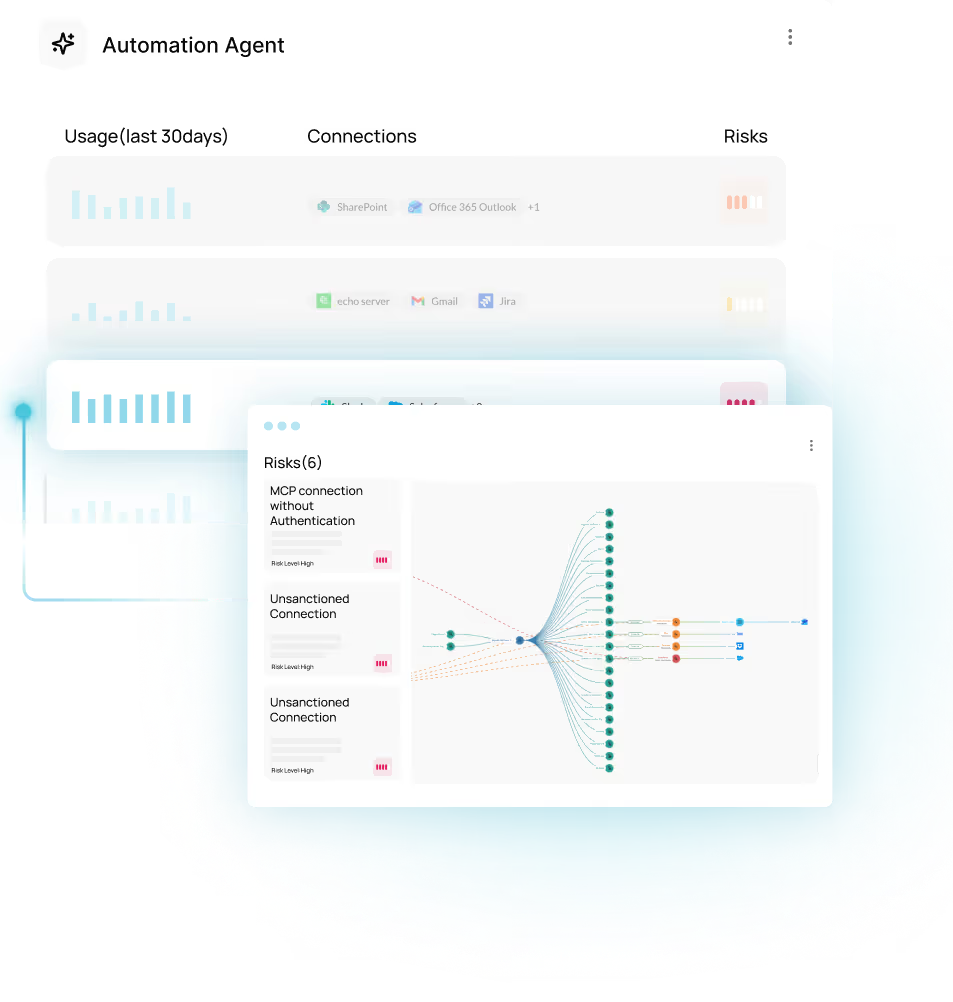
  • Limited view of AI agents:
    AI discovery tends to focus on listing tools rather than tying agent behavior to identity, permissions and cross app interaction.

Why your peers choose Obsidian over CrowdStrike Falcon Shield

Organizations often choose Obsidian because the architecture keeps identity, permissions, token relationships and SaaS activity connected in one place. Rather than routing events through data processors or treating posture, access and activity as separate workflows, Obsidian collects and normalizes primary data directly, keeping those relationships intact.

This connected foundation helps teams understand how access is granted, how privileges chain across applications and where integrations may create unintentional reach. Unlike platforms that rely on static inventories and isolated logs, Obsidian maintains a continuously updated model that surfaces how identities and access evolve across apps.

Teams also value that Obsidian links posture, identity and activity as part of one system. When configurations change, approvals are bypassed, permissions drift or integrations gain new reach, the context is visible immediately. This helps teams prioritize the issues that matter and understand their environment with greater certainty.

The result is a clearer picture of how SaaS and AI systems interact, how privileges propagate and where access paths may create risk. This level of connected insight is what many organizations expect from a modern SaaS security platform.

Obsidian not only gives us centralized visibility but also provides insights into key areas that we simply don’t have without it. They became the obvious choice for us because of the depth in context and insights they provide across all critical areas of our SaaS ecosystem.”
We’ve saved an absolute ton of people hours through automation and data pulled from Obsidian”
Obsidian’s been able to scale with us wherever we’ve needed it to go”
You’ve revolutionized our incident response”
With Obsidian, we had all the integrations in place, ready to go, and a big catalog of threat detections out-of-the-box”
Headshot of Mario Duarte from Snowflake

Snowflake has hundreds of SaaS applications — to gain visibility into those SaaS applications could take months. With Obsidian we were able to do that in days, if not hours.

Mario Duarte, Vice President of Security, Snowflake

Headshot of Heather Akuiyibo from Databricks

Our partnership with Obsidian as a Built on Databricks Partner underscores a joint commitment to offer our customers a secure and unified platform for data, analytics and AI, that empowers fast and powerful insights.

Heather Akuiyibo, VP Go-To-Market, Databricks

Headshot of Øyvind Berget from Norma Cyber

Seeing threats across SaaS solutions in a single pane of view is critical to us. Obsidian promises always-on monitoring and protection, and meets the compliance standards that our members need to operate seamlessly.

Øyvind Berget, Chief Technical Officer, Norma Cyber

Obsidian vs CrowdStrike Falcon Shield FAQs

How is Obsidian's architecture different from Falcon Shield?

Falcon Shield extends endpoint and identity workflows into SaaS, creating posture and settings-driven visibility. Obsidian's Knowledge Graph collects and normalizes SaaS identity, permissions and activity directly, keeping relationships intact and giving teams a connected view of how access evolves across applications.

What is connected context?

Connected context means seeing how identities, tokens and integrations relate in real time through Obsidian's Knowledge Graph, rather than stitching together fragmented signals from multiple sources.

Why does this matter for security teams?

Posture-centric platforms like Falcon Shield often leave teams manually correlating SaaS logs, IdP events and integration data to understand multi-step behavior. Obsidian's Knowledge Graph shows these relationships continuously, helping teams interpret changes quickly and with confidence.

How does this improve decision-making?

A single connected view of identity, access and activity helps teams prioritize issues faster, understand impact clearly and act with greater speed.

What visibility does each platform provide into local and shadow access?

Falcon Shield focuses on IdP-managed access and may lose visibility when users authenticate directly into SaaS or adopt unsanctioned tools. Obsidian's Knowledge Graph detects federated, local and shadow access paths using HR, IdP, SaaS and browser telemetry tied back to real identities.

How does each platform approach AI agent security?

Falcon Shield promotes AI discovery but appears limited in connecting agent behavior to identity context or cross-application permissions. Obsidian's Knowledge Graph unifies agent activity with identity, entitlements and SaaS workflows, helping teams understand how agents use their access and where privilege expansion may occur.

Ready to see the difference yourself?

See what gives Obsidian the edge over others

Request a Demo to see Obsidian in action!